ZZ Plant Yellow Leaves: A Complete Diagnostic & Rescue Guide

There are few things more alarming — or more confusing — than watching a plant that’s supposedly impossible to kill slowly turn yellow on you. If your ZZ plant’s glossy leaves have gone from deep emerald to sickly yellow and you have no idea why, you’re in the right place.
The good news: in the vast majority of cases, this is fixable. The bad news: jumping to the wrong conclusion and treating the wrong cause can make things significantly worse. That’s exactly why this guide exists — to help you read the clues your plant is giving you and take the right action the first time.
For a full overview of ZZ plant care fundamentals, check out our Ultimate ZZ Plant Care Guide. But if you’re here because something has gone wrong and you need answers fast, keep reading.
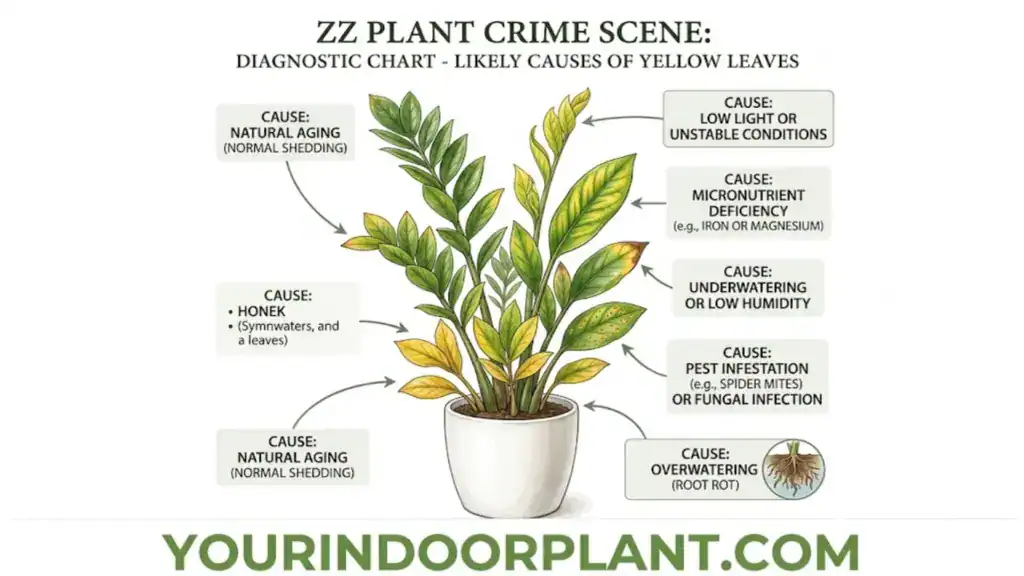
The “Crime Scene” — Reading the Yellow Leaves Accurately
Before you repot, trim, or change anything, spend two minutes observing carefully. The pattern of yellowing is the single most important diagnostic clue.
Ask yourself these questions:
- Which leaves are yellowing — old ones at the base of the stems, or new ones at the tips?
- Old lower leaves yellowing = likely natural aging or overwatering
- New upper leaves yellowing = likely a nutrient issue (especially iron or nitrogen) or root damage
- How many leaves are affected?
- One or two leaves on an older stem = probably natural leaf drop, not a crisis
- Multiple leaves across several stems = a systemic problem that needs immediate attention
- What does the yellowing look like?
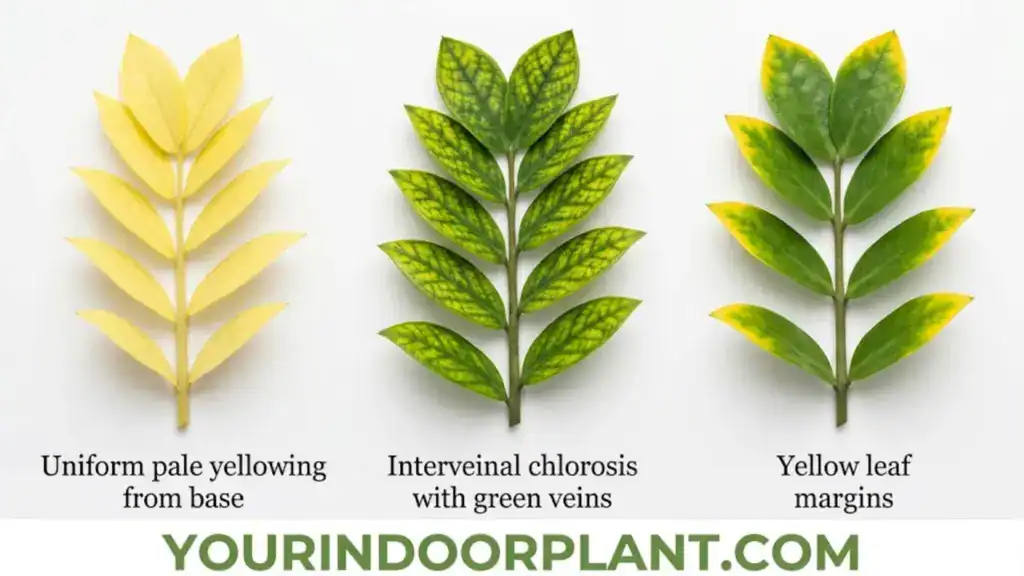
- Uniform pale yellow across the whole leaf = overwatering, low light, or nitrogen deficiency
- Yellow with green veins (interveinal chlorosis) = iron or magnesium deficiency
- Yellow edges or tips only = salt buildup, underwatering, or direct sun exposure
- Yellow patches or spots = pest damage or direct sun scorching
- How does the stem feel?
- Firm and upright = good sign; the vascular system is intact
- Soft, mushy, or collapsing = root rot has progressed significantly
- What does the soil look like and feel like?
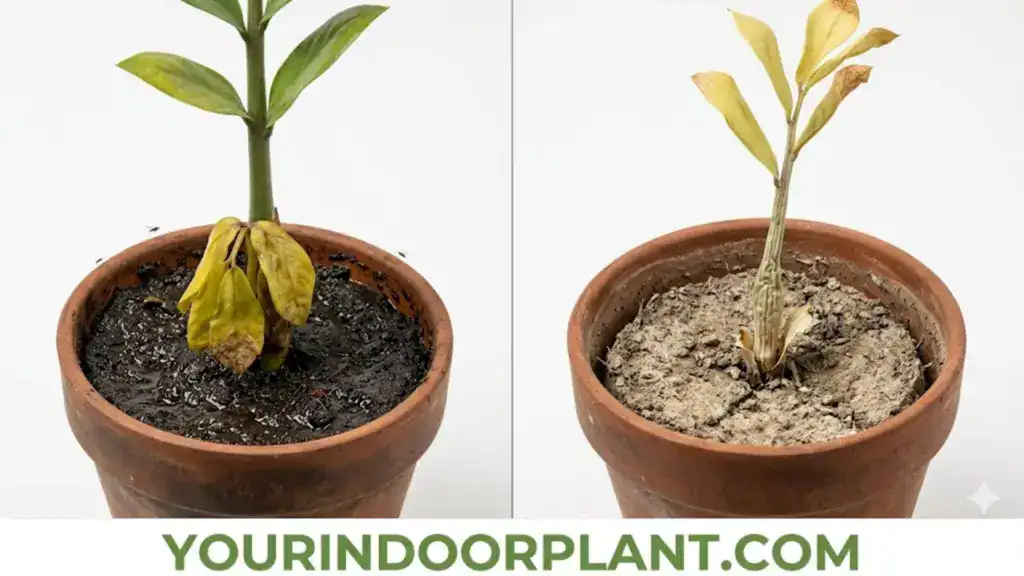
- Soggy or dark and wet = overwatering is the prime suspect
- Bone dry and pulling away from the pot edges = underwatering or severe drought stress
- When did it start?
- After repotting = transplant shock
- After moving to a new location = light or temperature change
- Gradual and slow = more likely a chronic care issue
Cause #1: Overwatering (The #1 Culprit by Far)
This is responsible for the majority of ZZ plant yellow leaf cases. ZZ plants store water in their rhizomes, making them highly drought-tolerant — and excess moisture causes root rot that manifests as yellow leaves.
Why it happens biologically: When roots sit in waterlogged soil, oxygen can’t reach them. Anaerobic bacteria multiply and attack root tissue, causing rot. Rotted roots can no longer transport water and nutrients up the stems — so even in wet soil, the plant essentially starves. The leaves yellow from the bottom up as a result.
How to confirm it:
- Soil feels wet or damp more than 3–4 days after watering
- Lower leaves are yellowing across multiple stems
- There’s a musty or sour smell from the soil
- When you unpot the plant, roots are brown, slimy, or mushy rather than firm and white
Step-by-step rescue plan:
- Stop watering immediately. Don’t water again until you’ve assessed the roots.
- Unpot the plant gently. Slide it out and inspect the root ball and rhizomes.
- Trim all rotted roots. Use sterilized scissors or pruning shears. Rotted roots are brown, soft, and hollow — healthy roots are firm and light-colored. Cut back to healthy tissue.
- Let the roots air dry for 30–60 minutes before repotting. This helps cut surfaces callous slightly.
- Repot in fresh, dry mix. Use a well-draining blend: 50% potting mix + 25% perlite + 25% coarse sand or orchid bark. Do not reuse the old soggy soil.
- Choose the right pot size. Don’t go larger — a pot that’s too big holds excess moisture. Match the current root mass.
- Water sparingly for the first few weeks. Just enough to moisten the soil; let it dry fully before watering again.
Prevention going forward:
- Always test soil moisture before watering — insert your finger 2 inches deep and water only if completely dry. A moisture meter is even more reliable.
- Use pots with drainage holes. No exceptions.
- A general schedule: every 3–4 weeks in summer, every 6–8 weeks in winter — but treat this as a rough starting point, not a rule. Always defer to what the soil is telling you.
Common Mistake: Assuming that because the surface looks dry, the soil is dry throughout. ZZ plant pots can be bone dry at the top and still quite moist several inches down, especially in larger pots or denser soil mixes. Always go 2 inches deep with your finger or use a moisture meter.
Cause #2: Underwatering (Less Common, But Real)
Yellowing leaves can also be a sign of underwatering, though this is far less frequent with ZZ plants than overwatering. Because ZZ plants store water in their rhizomes, they can tolerate drought for extended periods — but eventually they’ll show distress.
How to tell it apart from overwatering:
- Soil is bone dry and pulling away from the pot edges
- Stems look slightly shriveled or wrinkled (the rhizomes have depleted their water reserves)
- Leaves feel thin and papery rather than firm and waxy
- The soil is bone dry and the leaves look dry and yellow — both conditions present together
How to fix it:
- Give it a deep, thorough soak. Set the pot in a basin of water for 20–30 minutes and let it absorb water from the bottom up (bottom watering). This ensures the rhizomes and deeper roots actually get hydrated.
- Drain fully. Never let it sit in standing water afterward.
- Adjust your watering schedule. If you’ve been going 8–10 weeks between waterings, pull that back slightly — especially in warm or dry months.
Prevention: Check your plant at least every 2 weeks, even in winter. A quick finger-test takes five seconds and saves weeks of recovery time.
Cause #3: Too Much Direct Sunlight
If your ZZ plant is sitting in direct sunlight, this could be the cause of its yellow leaves, which will ultimately scorch and turn brown. The glossy surface of ZZ leaves is deceptive — it looks like it should deflect harsh light, but it actually focuses it and burns the leaf tissue underneath.
Distinctive symptoms:
- Yellow patches or pale, washed-out spots on the parts of the leaf facing the light source
- Patches that transition to papery brown or white at the center (bleaching/scorching)
- Problems concentrated on the side of the plant facing the window
- Direct sunlight leading to leaf burn, manifesting as yellow or brown spots
How to fix it:
- Move the plant back from the window — aim for 5–8 feet from a south or west-facing window, or position it beside (not in front of) an east-facing window.
- Use a sheer curtain to filter intense afternoon light if moving isn’t practical.
- Don’t remove scorched leaves immediately unless they’re fully browned. Yellowed leaves still contribute some photosynthesis while the plant recovers.
Prevention: ZZ plants are low-to-medium light plants by nature. East-facing windows are ideal, providing morning light without the intensity of midday or afternoon sun.
Cause #4: Natural Leaf Aging
This one surprises many ZZ plant owners — and causes a lot of unnecessary panic.
ZZ plants naturally shed older leaves at the base of their stems as they grow. This is not a crisis. The plant is simply redirecting energy from old leaves to new growth. It’s the botanical equivalent of a tree losing its lower branches as it matures.
How to identify natural aging:
- Only one or two leaves are yellowing at the very base of a single stem
- The rest of the plant looks healthy — firm stems, glossy green leaves, possibly even new growth emerging
- No mushy tissue, no soggy soil, no pests
- The yellowing progresses slowly over a week or two before the leaf drops
This indicates healthy growth patterns, not distress. Forcing intervention here often causes more harm than good.
What to do: Nothing urgent. Only remove leaves that are 90% yellowed. Premature pruning stresses the plant. Use sterilized scissors to cut at the base, leaving a small brown stalk that will dry naturally. Never pull leaves off manually.
Rule of Thumb: One or two yellow leaves per month on a healthy-looking plant = natural aging. Three or more yellow leaves simultaneously across multiple stems = a problem worth investigating.
Cause #5: Nutrient Deficiency
Less common than watering issues, but worth investigating if your ZZ plant has been in the same pot for years without any fertilizing.
Lack of nitrogen causes older leaves to yellow. Potassium deficiency tends to turn the edges of leaves yellow. If the veins of older leaves are yellowing, the problem could be magnesium deficiency. When new leaves turn yellow, iron chlorosis is often the culprit.
Pattern guide:
| Yellowing Pattern | Most Likely Deficiency |
|---|---|
| Uniform pale yellow, older leaves first | Nitrogen |
| Yellow leaf edges, green center | Potassium |
| Yellow between leaf veins (veins stay green) | Magnesium or Iron |
| New leaves emerge yellow | Iron (chlorosis) |
How to fix it:
- Start with a balanced liquid fertilizer (10-10-10 or 20-20-20) diluted to half strength. This covers nitrogen and potassium.
- For magnesium deficiency: A diluted Epsom salt solution (1 tsp per gallon of water, applied once monthly) works well.
- For iron chlorosis: Use a chelated iron fertilizer — this form of iron is far more available to plant roots than standard iron.
- Don’t over-correct. Over-fertilizing causes its own problems. Fertilize once a month in spring and summer only.
Common Mistake: Assuming a yellowing ZZ needs fertilizer before ruling out watering issues. Nutrient problems in ZZ plants are almost always secondary — fix the watering first, then assess nutrition.
Cause #6: Pests
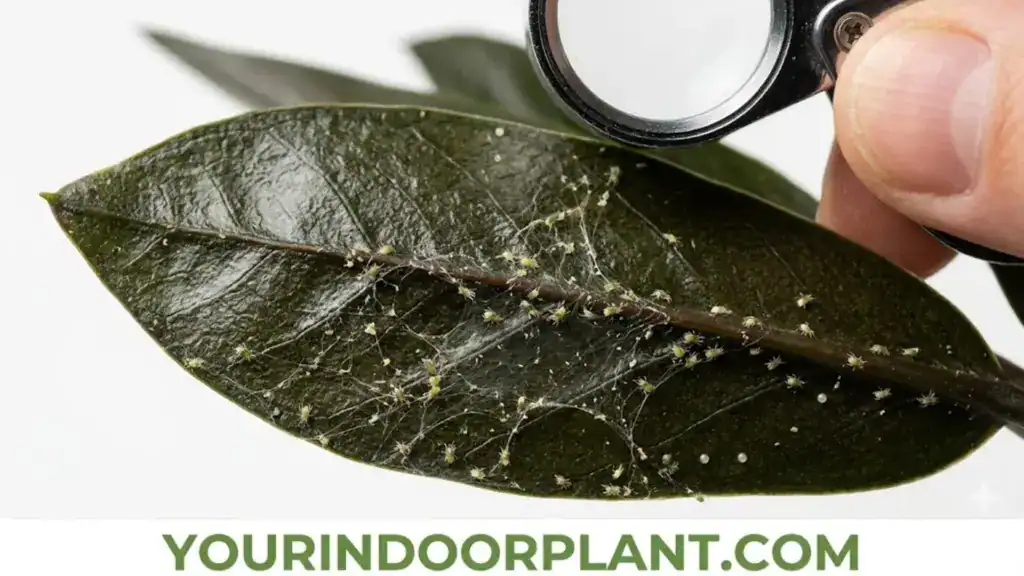
Weakened or stressed ZZ plants become more susceptible to insect infestations. Sap-sucking bugs like spider mites can drain your plant of moisture. Scale, mealybugs, and spider mites occur frequently in indoor conditions. The piercing mouths of the insects exhaust your plant and accelerate yellowing, especially if your ZZ is already unhealthy from a nutrient deficiency or improper soil moisture.
How to spot them:
- Fine webbing on stems or leaf undersides (spider mites)
- White cottony clusters in leaf joints (mealybugs)
- Brown, shell-like bumps on stems (scale)
- Looking closely at both top and bottom sides of leaves — you may see pests scurrying, or clusters of tiny eggs
- Sticky residue on leaves or surrounding surfaces (honeydew from sap-suckers)
Step-by-step treatment:
- Isolate the plant immediately to prevent spreading to other houseplants.
- Wipe leaves manually. Use a damp cloth or cotton pad dipped in rubbing alcohol (70%) to physically remove as many pests as possible. Get both leaf surfaces and stem joints.
- Apply neem oil solution. Mix cold-pressed neem oil (2 tsp) with a drop of dish soap in 1 liter of water. Spray the entire plant, including undersides of leaves and stem joints.
- Repeat every 5–7 days for 3–4 weeks. One treatment is never enough — you need to break the reproductive cycle.
- Monitor weekly after treatment for signs of return.
Prevention: Regular inspections are essential — often it is hard to spot when a plant gets attacked, as the culprits are very small and are good at camouflage. Check new plants carefully before introducing them near existing houseplants.
Cause #7: Transplant Shock or Root Disturbance
Did the yellowing start within a few weeks of repotting? This is likely transplant shock — a temporary stress response as the root system adjusts to new soil and a new environment.
Symptoms: Sudden yellowing of multiple leaves, possibly some leaf drop, following repotting or significant root disturbance.
What to do:
- Don’t repot again. The worst thing you can do is uproot the plant a second time.
- Keep it in stable, warm conditions — away from cold drafts and direct sun.
- Water normally but don’t fertilize for at least 4–6 weeks.
- Be patient. Most ZZ plants stabilize within 4–8 weeks post-repotting.
When to Worry vs. When to Wait
Not every yellow leaf is an emergency. Here’s a practical framework:
| Situation | Urgency | Action |
|---|---|---|
| 1–2 lower leaves yellowing, rest of plant looks healthy | Low — likely natural aging | Monitor; remove when 90% yellow |
| 3+ leaves yellowing across multiple stems | Medium — investigate watering | Check soil moisture; adjust care |
| Yellowing + mushy stems or soggy soil | High — likely root rot | Unpot and inspect roots immediately |
| Yellowing + visible pests | High | Isolate and treat immediately |
| Yellowing + new growth also affected | Medium-High | Check for nutrient deficiency |
| Yellowing after moving plant | Low-Medium | Allow 2–3 weeks to acclimate before intervening |
The core principle: A ZZ plant can lose a leaf or two a month through natural aging without any cause for concern. The alarm bells should ring when yellowing is rapid, widespread, or accompanied by soft stems, soggy soil, or visible pests.
Conclusion
Yellow leaves on a ZZ plant are almost always telling you something specific — and once you learn to read the clues, diagnosing the problem is genuinely straightforward. Work through the causes in order: check the watering and soil moisture first (it’s the answer 70–80% of the time), then assess light conditions, then check for pests, then consider nutrition.
The ZZ plant is remarkably resilient. Give it the right conditions and fix the underlying issue, and it will bounce back — often producing fresh, glossy new growth within a few weeks as proof that you got it right.
For the full picture on ZZ plant care, head over to our Ultimate ZZ Plant Care Guide. And if you’re dealing with other issues, these guides may also help:
- [ZZ Plant Brown Tips: Causes and Fixes]
- [How to Repot a ZZ Plant Without Damaging the Rhizomes]
- [Best Soil Mix for ZZ Plants and Other Drought-Tolerant Houseplants]
Which cause matched your ZZ plant’s symptoms? Let me know in the comments — I’d love to hear if this guide helped you figure it out.