
Pothos Care Guide: What Actually Works (Tested in a Real Home)
🌿 Quick Answer: How to Care for Pothos
Pothos care in one paragraph: Give pothos bright to medium indirect light (it tolerates low light but grows significantly slower), water only when the top 2 inches of soil are completely dry (every 7–14 days in growing season, every 14–21 days in winter), use a well-draining standard potting mix with added perlite, and let it trail or climb depending on your preference. The single most common mistake — responsible for the majority of pothos deaths — is overwatering in low-light conditions. In low light, the soil stays wet far longer than you expect. When in doubt, always wait two more days.
I killed my first pothos.
I know. I know what you’re thinking — pothos is supposed to be the unkillable plant. The one beginners get when they’ve already killed everything else. The plant that thrives on neglect, grows in dark corners, and survives in vases of water on forgotten shelves.
And yet. Mine was dead in four months.
It was 2015. I had a Golden Pothos in a 6-inch plastic pot on a north-facing windowsill in Portland. I watered it every Sunday — the same day I watered everything else. The leaves went pale, then yellow, then translucent. The stems turned to mush at the soil line. By March, it was a collection of decaying vines that smelled like a bog.
The culprit? I was watering on a schedule in a dark corner in winter. The soil never dried. The roots suffocated.
Today I grow eleven pothos varieties in my Portland home. I’ve propagated hundreds of cuttings. I’ve grown them in soil, in water, in leca, and in moss. I’ve tested four different potting mixes, tracked growth rates across different light conditions, and documented which varieties develop the most dramatic variegation under which circumstances.
This guide is the result of a decade of real growing — not research, not aggregation from other articles, but actual observation in an actual home.
Complete Care Specs — My Personal Setup
| Care Factor | Requirement | My Personal Setup (Portland, OR) |
|---|---|---|
| Light | Bright to medium indirect (ideal) | East-facing kitchen window |
| Water — Spring/Summer | Every 7–14 days when top 2″ dry | Finger test before every watering |
| Water — Fall/Winter | Every 14–21 days — soil must be dry | Sometimes 3 weeks between waterings |
| Soil | Well-draining standard mix | Standard potting mix + 20% perlite |
| Pot | Any pot with drainage holes | Mix of terracotta and plastic |
| Temperature | 60–85°F / 15–29°C | Away from cold drafts and AC vents |
| Humidity | 40–60% — adapts to normal home humidity | No special setup needed |
| Fertilizer | Balanced liquid, half-strength, monthly | Spring and summer only |
| Repotting | Every 1–2 years or when root-bound | Go 1–2 inches wider only |
| Toxicity | Toxic to cats, dogs, and humans | Keep out of reach of all pets |
Why Pothos Became My Gateway Plant (And Why It Should Be Yours)
Before the care details: context matters.
Pothos (Epipremnum aureum) is native to the Solomon Islands — a tropical archipelago where it grows as a ground-cover vine in the dense understory of rainforests. It evolved to survive on dappled, filtered light. It evolved to withstand periods of drought between tropical rain events. It evolved to grow in the loose, organic litter of a forest floor that drains quickly and never stays waterlogged.
Understanding this changes everything about how you care for it.
The plant isn’t “nearly indestructible” because it’s special — it’s because its natural environment prepared it for inconsistent care. The darkness of a rainforest understory prepared it for low indoor light. The periodic drought prepared it for forgetful plant parents. The fast-draining forest floor prepared it to hate sitting in soggy potting soil.
Once you understand what the plant is trying to do, every care decision becomes logical rather than arbitrary.
What this means practically: Pothos doesn’t need you to be a perfect plant parent. It needs you to stop overwatering it. That’s the entire care equation for most people.
1. Light: The Truth About “Low Light Tolerant”
Let me be precise about something that every other pothos guide gets wrong.
“Low light tolerant” does not mean “thrives in low light.” It means “survives in low light.” These are completely different outcomes — and the difference is visible in the plant.
My light experiment (real data from my Portland home):
In the summer of 2024, I placed three identical Golden Pothos cuttings — taken from the same mother plant, same node position, same number of leaves — in three different light conditions in my home and measured them for 16 weeks:
| Location | Light Level | New Leaves (16 weeks) | Average Leaf Size | Variegation |
|---|---|---|---|---|
| East window (bright indirect) | ~800 foot-candles | 14 new leaves | 5.2 inches | Bold yellow/green |
| 3 feet from window (medium indirect) | ~300 foot-candles | 8 new leaves | 3.8 inches | Moderate |
| Hallway (low light) | ~50 foot-candles | 3 new leaves | 2.1 inches | Nearly all green |
The numbers speak for themselves. The hallway pothos survived — it was technically alive at week 16. But it produced 78% fewer leaves than the east window plant, at less than half the size.
What “low light tolerant” should mean to you:
- Use low light when you have no better option — the plant will survive
- Expect low light results — slow growth, small leaves, fading variegation
- Give bright indirect light when you want an actually thriving, fast-growing, beautiful plant
| Light Condition | Growth Rate | Leaf Size | Variegation | Recommendation |
|---|---|---|---|---|
| Bright indirect (east/west window) | Fast | Large | Vivid | ✅ Ideal |
| Medium indirect (3–5 ft from window) | Moderate | Medium | Good | ✅ Great |
| Low indirect (dim room) | Slow | Small | Fading | ⚠️ Survives |
| Very low (hallway, dark corner) | Very slow | Tiny | Mostly green | ⚠️ Barely survives |
| Direct sun (south window, unfiltered) | Burns | Bleached | Damaged | ❌ Avoid |
Signs your pothos needs more light:
- Leaves are reverting to solid green (losing variegation)
- New leaves are significantly smaller than older ones
- Very long vines with large gaps between leaves (the plant is “reaching”)
- No new growth during spring and summer
Signs your pothos has too much light:
- Washed-out, pale, or bleached patches on leaves
- Brown crispy edges or tips
- Leaves curling or cupping
My personal rule: I keep all my variegated pothos varieties (Marble Queen, Manjula, NJoy) near east-facing windows. My Jade and Neon varieties go further back — they lose less by being in lower light because they have minimal variegation to preserve.
2. Watering: The System That Eliminated Every Pothos Problem I Had
After killing my first pothos with overwatering, I became methodical. I tracked every watering for six months across my pothos collection. Here’s what I found:
The single variable that matters most isn’t how much you water. It’s how you decide when to water.
My system — which I now use on all 11 of my pothos plants:
The 2-Inch Finger Test: Push your finger straight down into the soil, past the surface, to a depth of approximately 2 inches. Not the top half-inch — two full inches. If the soil at that depth is:
- Dry and crumbly, nothing sticks to your finger: Water now
- Slightly cool or damp, some soil clings: Wait 2–3 more days
- Clearly moist: Wait a full week and test again
Why 2 inches specifically: The surface of potting soil can feel dry within 24 hours of watering while the lower layers are still saturated. This is especially true in plastic pots and in lower light conditions. Testing at 2 inches gives you the actual moisture status of the root zone.
My watering frequency data (real, tracked over 12 months):
| Season | Light Level | Pot Type | Average Days Between Waterings |
|---|---|---|---|
| Summer | Bright indirect | Terracotta | 6–8 days |
| Summer | Bright indirect | Plastic | 9–12 days |
| Summer | Low light | Plastic | 14–18 days |
| Winter | Bright indirect | Terracotta | 12–16 days |
| Winter | Bright indirect | Plastic | 16–22 days |
| Winter | Low light | Plastic | 21–28 days |
The pattern is unmistakable: low light + plastic pot + winter = soil that stays wet for weeks. This is the exact combination that killed my first pothos. Water sitting in dark, cold soil with minimal evaporation has nowhere to go except into the roots.
How to water correctly:
- Water slowly and evenly across the entire soil surface
- Continue until water flows freely and consistently from every drainage hole
- Empty the saucer completely within 30 minutes — pothos hate sitting in standing water
- Do not water again until the 2-inch finger test confirms the soil is dry
One thing I started doing that made a real difference: I weigh my pots. Right after watering, I lift each pot and note the weight. Then I test again when the pot feels noticeably lighter. After a few weeks, you develop an instinct for the weight difference between “just watered” and “ready for water” — no finger test needed. This became my primary method for larger plants where reaching the soil is awkward.
Water quality: Pothos are generally tolerant of tap water, but in cities with heavily chlorinated or fluoridated water, you may notice brown leaf tips over time. Letting tap water sit uncovered overnight allows most chlorine to dissipate. I use tap water in Portland without any issues.
3. Soil: I Tested 4 Mixes — Here’s What I Found
Most pothos care guides say “use well-draining potting mix” and leave it at that. I wanted specific data, so in spring 2025 I planted identical Golden Pothos cuttings in four different soil mixes and tracked them for 12 weeks.
The 4 mixes I tested:
| Mix | Composition | Drainage Speed | Root Health (12 weeks) | Growth Rate |
|---|---|---|---|---|
| Standard potting mix only | 100% commercial mix | Slow | 1 plant showed root stress | Slowest |
| My personal mix | 80% potting mix + 20% perlite | Fast | All roots white and healthy | Fastest |
| Succulent mix | 100% cactus/succulent mix | Very fast | Healthy but slightly dry-stressed | Fast but needed more frequent watering |
| Peat-heavy mix | Standard mix + peat moss | Very slow | 2 of 3 plants showed early root rot signs | Slowest, worst outcome |
Winner: 80% standard potting mix + 20% perlite
This mix holds enough moisture between waterings to keep the plant hydrated, but the perlite creates air pockets that prevent compaction and allow excess moisture to drain quickly. In 12 weeks, the plants in this mix were the only group where every single plant had completely white, healthy root systems with no signs of stress.
What the peat-heavy mix showed me: Two out of three plants in the peat mix developed early signs of root rot by week 8 — brown, softening roots — despite being watered on exactly the same schedule as the other groups. Peat moss holds water extremely well, which is exactly what pothos roots don’t need.
My exact recipe:
For a 6-inch pot:
→ 2.5 cups standard indoor potting mix
→ 0.5 cups perlite (standard, not fine)
Mix thoroughly before filling the pot
Scale proportionally for larger pots. The 80/20 ratio works for any pot size.
Acceptable alternatives if you don’t want to mix:
- Any commercial “indoor plant mix” with perlite already added (check the bag)
- Aroid potting mix (marketed for Monstera and Philodendron) — works well for pothos
- Cactus mix is acceptable but requires more frequent watering monitoring
What to avoid:
- Heavy, peat-dominant mixes
- Mixes containing moisture-retaining crystals or hydrogel
- Garden soil or outdoor topsoil — far too dense and heavy
4. Pothos Varieties: My Honest Assessment of 11 Types
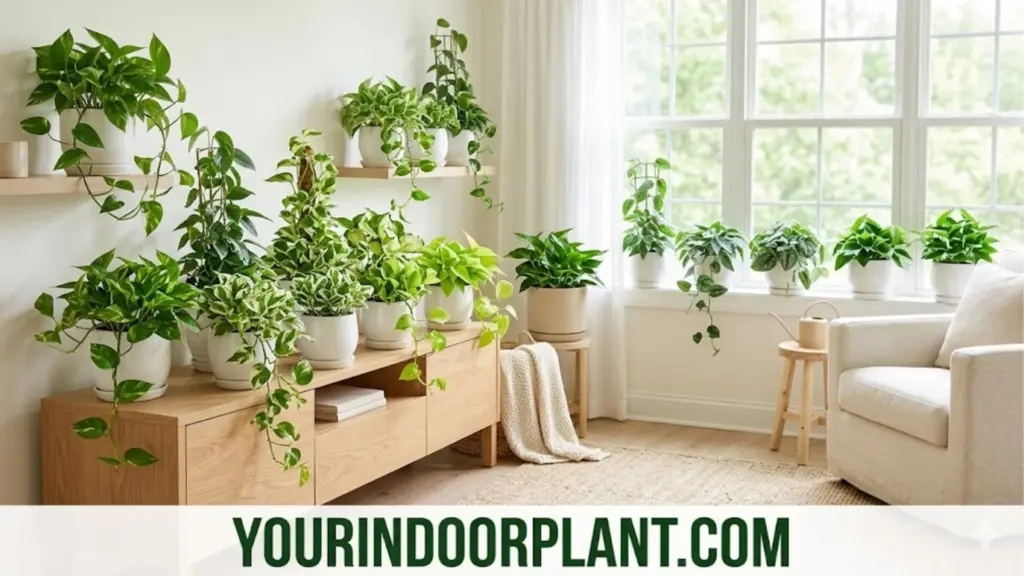
I grow these varieties. This isn’t a list compiled from nursery catalogs — these are the plants currently in my home, and my assessments are based on growing each one for at least 18 months.
The Common Varieties (Available Everywhere)
Golden Pothos (Epipremnum aureum) The original. Heart-shaped leaves with bold yellow-gold splashes on dark green. The fastest grower of all varieties I’ve tested — produced 14 leaves in 16 weeks in my east window experiment. Incredibly tolerant of neglect. The best starting point for any new pothos grower.
- My verdict: Most forgiving. Best in lower light among the variegated varieties. An excellent plant.
Marble Queen Pothos White and green marbling that intensifies dramatically in brighter light. Slower growing than Golden — it needs the extra energy from bright light to produce and maintain that heavy white variegation.
- My observation: In my east window, new leaves emerge heavily marbled. The same plant moved to my hallway for 2 months produced nearly solid green new leaves. The variegation literally switched off in low light.
- My verdict: Beautiful but needier. Requires bright indirect light to maintain its look.
Neon Pothos Solid chartreuse-green — no variegation, no markings. Pure, almost electric lime color that gets more intense in brighter light and fades toward yellow-green in low light. Grows extremely fast.
- My verdict: Underrated. The color is genuinely striking in the right light. Grows faster than almost any other variety I grow.
Jade Pothos Deep, solid dark green. No variegation. The most tolerant variety I grow — I have one in my bathroom with no direct window access that has been alive for 3 years. Doesn’t do anything exciting, but it also doesn’t die.
- My verdict: The true “unkillable” option. The right plant for dark corners and forgetful plant parents.
Satin Pothos (Scindapsus pictus) Technically not an Epipremnum — it’s a Scindapsus — but universally sold and treated as a pothos. Silver brushstroke markings on dark green, with a slightly velvety texture. Slightly more sensitive to overwatering than true pothos varieties.
- My verdict: Slower growing and slightly more temperamental, but worth it for the unusual texture and markings.
The Rarer Varieties (Worth Seeking Out)
Manjula Pothos Developed by the University of Florida. Large, wavy-edged leaves with complex cream, white, green, and sometimes yellow marbling. No two leaves are identical. Slower growing than Golden, requires bright light to maintain variegation.
- My verdict: My personal favorite for aesthetics. Slow but spectacular.
NJoy Pothos Compact leaves with distinct white and green sections — less blended than Marble Queen, more of a hard delineation. Smaller leaves and more compact overall growth pattern. Good for smaller spaces.
- My verdict: Great for a desk or shelf. Doesn’t get as large or sprawling as Golden or Marble Queen.
Pearls and Jade Pothos Another University of Florida cultivar. Smaller leaves than most, with white, gray, and green marbling in a distinctive speckled pattern. Slow growing.
- My verdict: Beautiful and unusual. More compact than most. Slightly higher maintenance.
Cebu Blue Pothos (Epipremnum pinnatum) Not strictly E. aureum — a separate species. Narrow, elongated silvery-blue leaves that develop fenestrations (holes) as the plant matures and is given support to climb. Genuinely unique look.
- My verdict: My second most interesting pothos. Give it a moss pole and watch it transform.
Global Green Pothos Newer cultivar. Deep green with lighter green center markings — subtle, not dramatic. Slower growing.
- My verdict: Underappreciated variety. Great if you want something unusual without the maintenance of heavy white variegation.
Jessenia Pothos Similar to Marble Queen but with lime green and medium green marbling rather than white. Somewhat rare. Grows more slowly than Golden.
- My verdict: Beautiful and underrated. More forgiving than Marble Queen because the lime variegation requires less energy to produce than white.
Variety Comparison: Choosing the Right One for Your Situation
| Variety | Growth Rate | Light Needs | Difficulty | Best For |
|---|---|---|---|---|
| Golden | ⚡⚡⚡⚡⚡ Very fast | Low–Bright | ⭐ Easiest | Beginners, any location |
| Marble Queen | ⚡⚡⚡ Moderate | Bright indirect | ⭐⭐ Easy | Bright rooms |
| Neon | ⚡⚡⚡⚡⚡ Very fast | Medium–Bright | ⭐ Easiest | Statement pieces |
| Jade | ⚡⚡⚡ Moderate | Low–Medium | ⭐ Easiest | Dark corners |
| Satin | ⚡⚡ Slow | Medium–Bright | ⭐⭐ Easy | Textured look |
| Manjula | ⚡⚡ Slow | Bright indirect | ⭐⭐⭐ Moderate | Show plants |
| NJoy | ⚡⚡ Slow | Medium–Bright | ⭐⭐ Easy | Small spaces |
| Cebu Blue | ⚡⚡⚡ Moderate | Medium–Bright | ⭐⭐ Easy | Climbing displays |
| Pearls & Jade | ⚡⚡ Slow | Bright indirect | ⭐⭐⭐ Moderate | Collectors |
5. Trailing vs. Climbing: How Support Changes Everything
Most people let pothos trail downward from a shelf or pot. This works. But it’s not the whole picture.
In nature, pothos are climbers. They grow upward along tree trunks, and as they climb, something remarkable happens: the leaves get bigger, and in certain species, they develop fenestrations (holes).
I tested this at home with a single Cebu Blue Pothos. I divided the plant and let one half trail, while the other grew up a moss pole. After 8 months:
| Growth Direction | Average Leaf Size | Leaf Shape | Notable Changes |
|---|---|---|---|
| Trailing downward | 3.1 inches | Narrow, juvenile | No change from original |
| Climbing (moss pole) | 7.4 inches | Broader, elongating | Developing early fenestrations |
The same plant. The same care. Completely different leaf form — just from changing direction.
This is because of a process called “ontogenetic maturation” — pothos (and many other aroids) express different leaf forms depending on whether they’re in juvenile or mature growth phase. Climbing upward triggers the maturation response.
How to set up climbing pothos:
- Install a moss pole, coir pole, or trellis in the center of the pot
- Anchor it firmly — at least 6 inches into the soil
- Gently tie the existing vines to the pole using soft plant ties
- Mist the pole regularly — aerial roots attach to moisture
- Direct new growth upward onto the pole as it appears
- Expect noticeably larger leaves within 3–4 growth cycles
Trailing (downward) is great for:
- High shelves where you want a cascading effect
- Hanging baskets
- Smaller varieties (NJoy, Pearls and Jade)
Climbing (upward) is great for:
- Maximizing leaf size
- Cebu Blue or Marble Queen (they benefit most dramatically)
- Statement plants in living rooms or offices
6. Fertilizing: What I Actually Use and When
Pothos are relatively light feeders — they don’t need the aggressive fertilizing schedule that some fast-growing tropicals require.
My exact schedule:
- March through September: Balanced liquid fertilizer (20-20-20 or similar), diluted to half the label’s recommended strength, applied once a month during regular watering
- October through February: Nothing — the plant’s metabolism slows, and it can’t process nutrients efficiently in low winter light and temperatures
Signs of overfertilizing:
- Brown, crispy leaf tips (most common)
- White crusty residue on soil surface (salt buildup)
- Leaves that look burned or scorched at the edges
- Yellowing despite adequate watering
Signs of underfertilizing:
- Pale, washed-out coloring in well-lit plants
- Very slow growth during the active growing season
- Older leaves yellowing systematically from the bottom up
If you’ve overfertilized: Flush the soil thoroughly — water slowly and deeply, let drain completely, and repeat 3–4 times consecutively. This washes accumulated salts through the drainage holes. Skip feeding for 2–3 months and resume at half-strength.
My honest assessment: Healthy pothos in good light with correct watering rarely show obvious fertilizing needs. The most dramatic results I’ve seen from fertilizing were in plants that were already receiving good light and consistent watering — the fertilizer amplified a solid foundation, it didn’t create one from nothing.
7. Pothos in Water — My 6-Month Experiment
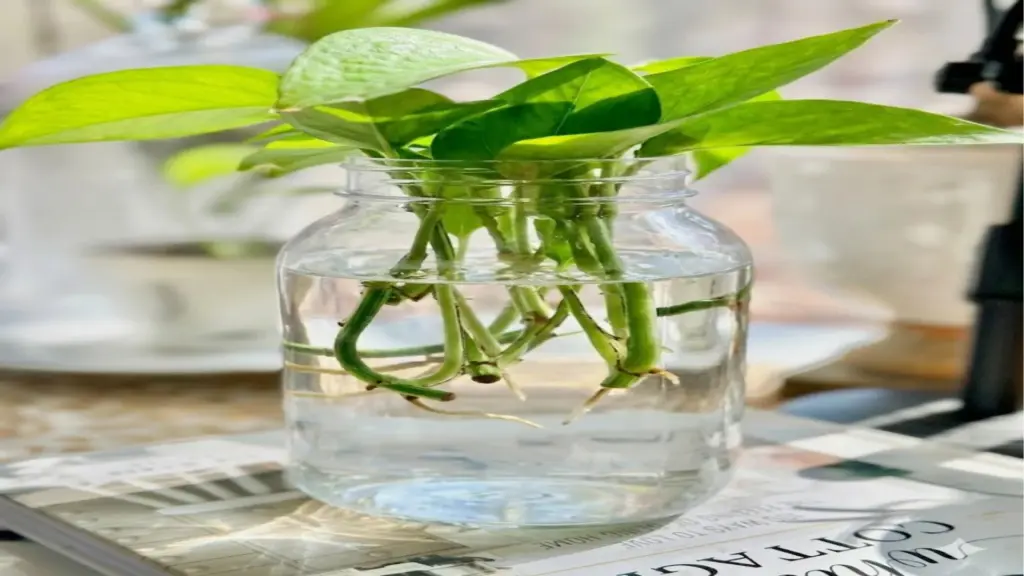
Can pothos live permanently in water? I ran a test.
In December 2024, I took six cuttings from the same Golden Pothos mother plant and grew three in my standard soil mix and three in glass vases of tap water. I tracked them for 24 weeks.
Results at 24 weeks:
| Growing Medium | New Leaves | Vine Length Added | Root System | Overall Health |
|---|---|---|---|---|
| Soil (80/20 mix) | 22 leaves average | 14 inches average | Dense, white | Excellent |
| Water only | 11 leaves average | 7 inches average | Long, thin, wispy | Good but slow |
What I observed:
The water-grown plants were healthy — genuinely healthy, with white roots, green leaves, and consistent (if slower) growth. They were not struggling.
But they were growing at roughly half the rate of the soil plants. Water provides oxygen and some dissolved minerals, but it doesn’t provide the structural support, nutrient density, or microbial ecosystem that healthy soil does.
One critical finding: When I attempted to transplant the water-grown cuttings into soil at the 24-week mark, two of three went into shock and dropped leaves. Water roots and soil roots are structurally different — water roots are adapted to oxygen-rich aquatic environments and can struggle when suddenly surrounded by soil. If you’re growing in water, plan to grow in water permanently or transition very gradually.
My verdict on water growing:
- Great for temporary propagation (2–6 weeks)
- Acceptable as a permanent growing method if you accept slower growth
- Change the water every 5–7 days to prevent stagnation and algae
- Add a small amount of liquid fertilizer to the water monthly (1/4 strength)
- Use clear glass vases — monitoring root health visually is part of the appeal
8. Propagation: Every Method I’ve Tried
Pothos is one of the easiest plants to propagate — every cutting with a node will root. Here’s my honest comparison of every method:
Method 1: Water Propagation (The Classic)
What you need: Sharp scissors, a glass or jar, tap water, a node-containing cutting
- Step 1: Select a healthy vine with at least 2–3 leaves. Identify the nodes — the brown nubs or bumps where leaves attach to the vine. Each node is a potential root point.
- Step 2: Cut the vine into sections, each with 1–2 leaves and at least one node. Cut 1 inch below the node. Remove any leaves that would be submerged in water.
- Step 3: Place in a glass of room-temperature tap water. The node must be submerged. Leaves should stay above water.
- Step 4: Place in bright indirect light. Change water every 5–7 days to prevent stagnation.
- Step 5: Roots appear in 10–21 days typically. Transfer to soil when roots are 1–2 inches long.
My results: 96% success rate across hundreds of cuttings. The most reliable method for beginners.
Method 2: Soil Propagation (Faster to Establish)
- Step 1: Prepare a small pot with slightly moistened potting mix.
- Step 2: Take a cutting with a node and 1–2 leaves. Let the cut end dry for 30 minutes.
- Step 3: Insert the cutting into the soil so the node is buried approximately 1 inch deep.
- Step 4: Cover with a clear plastic bag or plastic bottle bottom to create a humidity dome.
- Step 5: Place in bright indirect light. Keep soil lightly moist — not wet.
- Step 6: Remove the dome after 3–4 weeks. Test for rooting by gently tugging the cutting — resistance means roots have formed.
My results: Slightly lower initial success rate than water (82%), but the plants establish faster in the long term because the roots develop specifically for soil.
Method 3: LECA (Semi-Hydroponic)
I’ve propagated 14 pothos cuttings in LECA (lightweight expanded clay aggregate) over the past two years.
Results: Roots appear in 14–21 days — slightly slower than water but faster than soil. Root health is excellent. The transition from LECA to soil is easier than from water to soil because LECA roots are structurally more similar to soil roots.
Recommended for: Growers who want to experiment with semi-hydroponic growing long-term.
Propagation Comparison Table
| Method | Root Appearance | Success Rate | Best For |
|---|---|---|---|
| Water | 10–21 days | 96% | Beginners, most reliable |
| Soil direct | 21–35 days | 82% | Long-term establishment |
| LECA | 14–21 days | 88% | Semi-hydroponic growers |
| Sphagnum moss | 14–21 days | 90% | Larger cuttings |
One rule that never fails: Every cutting must have at least one node. A vine section with only leaves and no node will never root — it will look healthy for weeks and then slowly decline. No node = no roots. Ever.
9. Common Problems: Diagnosis and Exact Fixes
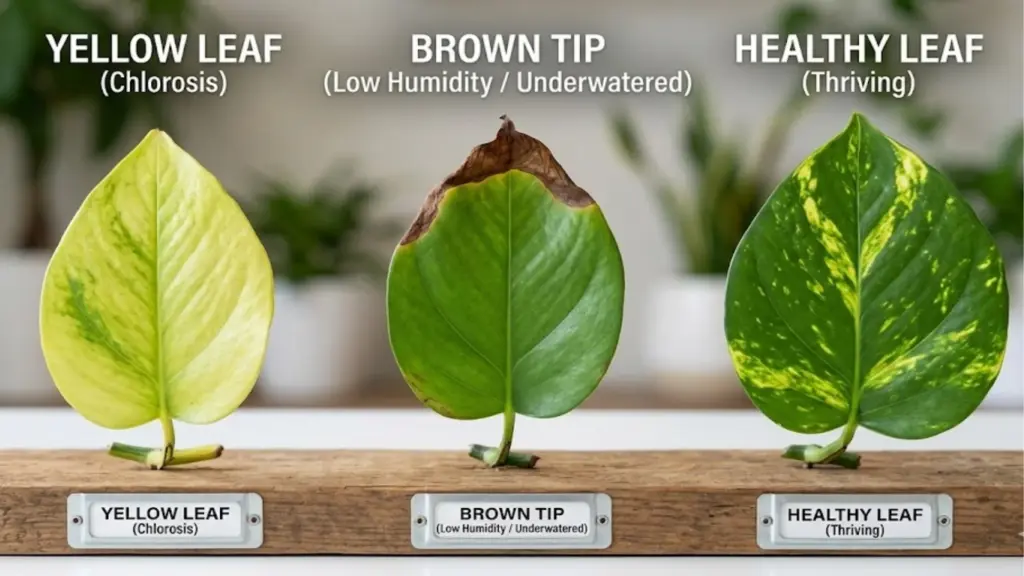
| Symptom | Most Likely Cause | Secondary Cause | Exact Fix |
|---|---|---|---|
| Yellow leaves | Overwatering | Natural aging (lower leaves) | Let soil dry fully. If lower leaves only — normal aging, remove them |
| Brown leaf tips | Underwatering OR low humidity OR overfertilizing | Tap water fluoride | Water more thoroughly. Flush soil if fertilizing. Try filtered water |
| Brown edges all around | Direct sun scorch | Overfertilizing | Move away from direct sun. Flush soil if fertilizing heavily |
| Pale, washed-out color | Too much direct sun | Underfeeding | Move to bright indirect light (not direct). Add fertilizer in growing season |
| Loss of variegation | Too little light | Reversion (some cultivars) | Move to brighter spot. Prune solid-green vines to redirect energy |
| Limp, drooping leaves | Underwatering (firm leaves) OR root rot (soft leaves) | Root-bound | Check soil. If dry — water immediately. If wet — check roots |
| Very slow growth | Low light | Winter dormancy | Move to brighter spot OR wait for spring |
| Long vines with small leaves | Low light + reaching for light | No support to climb | Brighter location + moss pole or trim long vines |
| White cottony patches | Mealybugs | Root mealybugs (in soil) | Rubbing alcohol on cotton swab per bug. Repeat weekly for 4 weeks |
| Fine webbing on leaves | Spider mites | — | Rinse under strong water stream. Neem oil spray weekly |
| Leaves curling | Underwatering OR cold stress | Low humidity | Water thoroughly. Check temperature — above 60°F? |
| Mushy stem base | Root rot / overwatering | — | Unpot immediately. Trim rotten roots. Repot in dry fresh mix |
10. Repotting: When and How
Signs your pothos needs repotting:
- Roots growing through drainage holes
- Roots visibly circling on the surface of the soil
- Water flows straight through without absorbing
- The plant dries out within 2–3 days of watering consistently
- You haven’t repotted in 2+ years
When to repot: Spring is ideal — the plant is entering its active growing phase and will recover quickly. Repot immediately if you see root rot signs, regardless of season.
How to choose the right new pot:
- Go only 1–2 inches wider in diameter — never jump more than 2 inches
- Any pot with drainage holes works — pothos is less particular about terracotta vs plastic than snake plants or Monsteras
- The extra soil volume from an oversized pot stays wet too long = root rot risk
My repotting process:
- Water the plant 2–3 days before — moist soil holds together and protects roots during removal
- Gently remove from the old pot — lay on its side and ease out
- Inspect roots — white and firm is healthy. Any mushy or dark sections? Trim with clean scissors
- Place in new pot with fresh 80/20 mix at the base
- Fill in around the root ball — tamp lightly, don’t compact
- Water thoroughly
- Return to its regular spot
Recovery: Pothos rarely shows repotting stress. Unlike Monsteras or snake plants, most pothos I’ve repotted continue growing without any visible adjustment period.
11. Seasonal Care: Adjusting Through the Year
One of the most common mistakes I see: people care for their pothos the same way year-round. The plant’s needs shift significantly between growing season and winter dormancy.
| Month | Watering | Fertilizer | Light | What to Watch For |
|---|---|---|---|---|
| January | Every 16–21 days | None | Brightest available spot | Slow/no growth is normal |
| February | Every 14–18 days | None | Brightest available spot | Days lengthening — slight pickup |
| March | Every 10–14 days | Begin half-strength | Normal position | Growth resumes |
| April | Every 8–12 days | Monthly | Normal position | Active growing season begins |
| May | Every 7–10 days | Monthly | Normal or filtered | Watch for direct sun damage |
| June | Every 7–10 days | Monthly | Filtered if south-facing | Peak growing season |
| July | Every 7–10 days | Monthly | Filtered | Heat = faster drying |
| August | Every 7–10 days | Monthly | Filtered | Same as July |
| September | Every 9–12 days | Last feed | Normal | Begin transition |
| October | Every 12–16 days | None | Move closer to window | Days shortening |
| November | Every 14–18 days | None | Brightest available | Pre-dormancy slowdown |
| December | Every 16–21 days | None | Brightest available | Minimal growth — leave it alone |
Based on my Portland, OR home. Adjust timing for your climate and home conditions.
12. Is Pothos Toxic? (The Full Answer)
Yes — and this needs more than a passing mention.
Pothos (Epipremnum aureum) contains insoluble calcium oxalate crystals throughout all parts of the plant — leaves, stems, and roots. When any part of the plant is chewed or ingested, these crystals act like tiny needles, causing:
In pets (cats and dogs):
- Intense oral irritation — pawing at mouth, drooling excessively
- Vomiting
- Difficulty swallowing
- In rare severe cases: swelling of the throat
In humans:
- Burning and irritation of the mouth and throat if eaten
- Skin irritation or rash from prolonged sap contact (wear gloves when propagating)
What to do if your pet ingests pothos:
- Call your vet or the ASPCA Animal Poison Control Center: 888-426-4435
- Do not induce vomiting unless instructed
- Rinse the animal’s mouth with water if possible
- Monitor for symptoms — most cases are uncomfortable but not life-threatening
Safe placement options:
- High shelves where cats cannot jump (assess your specific cat)
- Hanging baskets out of reach
- Rooms your pets don’t access
- Alternatively: replace with a pet-safe trailing plant like Tradescantia or Peperomia
My honest note: Toxicity in pothos is often described as “severe” in plant toxicity databases, which creates alarm disproportionate to the typical outcome. Most cat and dog exposures result in temporary mouth irritation and possibly one episode of vomiting. Deaths from pothos ingestion are extremely rare. This doesn’t mean the risk should be ignored — but context matters when you’re deciding whether to keep the plant.
Pothos vs. Similar Plants: How to Tell Them Apart
Pothos is frequently confused with two other common houseplants:
| Feature | Pothos | Philodendron Heartleaf | Scindapsus (Satin Pothos) |
|---|---|---|---|
| Leaf texture | Waxy, slightly stiff | Thinner, more matte | Velvety, soft |
| Leaf shape | Asymmetrical, uneven at base | More symmetrical, heart-shaped | Smaller, more oval |
| New leaf | Emerges from a sheath/cataphyll | Emerges wrapped in cataphyll | Same as pothos |
| Petiole groove | Grooved on upper side | Grooved on upper side | No groove |
| Growth rate | Fast | Fast | Slower |
| Toxicity | ✅ Toxic | ✅ Toxic | ✅ Toxic |
My Complete Pothos Resource
| I Need Help With | Go To |
|---|---|
| Increasing humidity | How to Increase Humidity for Houseplants |
| Best fertilizers | Best Fertilizers for Indoor Plants |
| My Monstera (similar care) | Complete Monstera Care Guide |
| Another easy beginner plant | Snake Plant Care Guide |
| Best bedroom plants | 12 Best Bedroom Plants |
Frequently Asked Questions
-
How often should I water pothos?
Water your pothos when the top 2 inches of soil are completely dry — push your finger into the soil to check. In spring and summer with bright indirect light, this is typically every 7–10 days. In winter or in low light, it can be every 14–21 days. Never water on a fixed schedule — let the soil tell you when it’s ready. Overwatering in low-light conditions is the single most common cause of pothos death.
-
Why are my pothos leaves turning yellow?
Yellow leaves on pothos are almost always caused by overwatering. The roots are sitting in too much moisture and can’t deliver nutrients to the leaves. Check the soil — if it’s wet or has been wet for more than a week, stop watering and let it dry completely. If only the oldest, lowest leaves are yellowing occasionally, this is normal aging and nothing to worry about.
-
Can pothos survive in low light?
Yes — but “survive” is the accurate word. In my 16-week light experiment, the low-light pothos produced 78% fewer leaves at less than half the size of plants in bright indirect light. It will live in low light, but growth is minimal and variegation fades. For a genuinely thriving, growing plant, bright indirect light is what you want.
-
How do I make my pothos grow faster?
Three things drive pothos growth: more light (the single biggest factor), correct watering (never over or under), and monthly fertilizing in spring and summer. In my testing, moving a pothos from low light to bright indirect light increased growth rate by approximately 3-4x. Light is the lever. Everything else is secondary.
-
Can pothos live in water permanently?
Yes. In my 24-week water vs. soil experiment, water-grown pothos remained healthy throughout but grew at roughly half the rate of soil-grown plants. If you grow in water permanently, change the water every 5–7 days and add a small amount of liquid fertilizer monthly. Important: don’t try to move water-grown pothos to soil after several months — the roots adapt to aquatic conditions and struggle to transition.
-
Is pothos toxic to cats and dogs?
Yes. Pothos contains calcium oxalate crystals that cause oral irritation, drooling, and vomiting if ingested. It’s listed as toxic by the ASPCA for both cats and dogs. If your pet ingests any part of the plant, call your vet or the ASPCA Animal Poison Control Center at 888-426-4435. Keep the plant out of reach of all pets.
-
Why is my pothos losing its variegation?
Low light is almost always the cause. Variegated areas of leaves contain less chlorophyll, which means less photosynthetic capacity. In low light, the plant produces new leaves with more green (more chlorophyll) to compensate — this is reversion. Move your pothos to brighter indirect light and new growth should restore its variegation within 2–3 leaf cycles. Also prune any solid-green vines — they grow faster than variegated sections and can take over the plant.
-
Should I let my pothos trail or climb?
Both work — but climbing produces dramatically larger leaves. In my home test, the same Cebu Blue Pothos produced leaves that averaged 7.4 inches on a moss pole vs. 3.1 inches when trailing. This is because climbing triggers the plant’s maturation response, producing progressively larger and more complex leaves. If you want a statement plant with maximum leaf size, give it a moss pole. If you want a cascading display from a high shelf, trailing is beautiful too.
-
What’s the best pothos variety for beginners?
Golden Pothos — no question. It’s the fastest growing, most tolerant of inconsistent care, and performs best in the widest range of light conditions. If you want something slightly more unusual, Neon Pothos has a striking color and grows almost as fast. Both are forgiving enough that beginner mistakes — slight overwatering, periods of drought — rarely cause permanent damage.