
How I Increase Humidity For My Houseplants (After Killing Too Many)

My first winter in Portland, I nearly killed a Calathea ornata.
The leaves curled so tightly they looked like green cigars. I checked the soil. Moist. I checked the light. Fine. Then I checked the humidity in the room: 20%.
Twenty percent.
That was the day I learned that humidity isn’t a “nice to have” for tropical houseplants. It’s the difference between a plant that thrives and one that slowly dies.
Over the last three years, I’ve tested almost every humidity method you’ll find on the internet. Misting. Pebble trays. Grouping. Humidifiers. Bathroom moves. I measured everything with a digital hygrometer and tracked what actually moved the needle.
The result? 90% of the advice out there is noise. Three methods work. The rest are either myths or maintenance nightmares.
Here’s everything I learned, starting with what you should never do.

Stop Misting Your Plants (Science Says So)
I know this is controversial.
Every plant influencer on social media shows themselves gently misting their Monstera with a pretty glass bottle. I used to do it too. It feels like plant care.
But here’s the truth I found after measuring:
Misting raises humidity around a leaf for less than 10 minutes. Not my opinion—this is backed by plant physiology research. Once the water evaporates, the humidity drops right back to room level.
Worse, constant misting can invite fungal issues on leaves that stay wet too long.
I haven’t misted a single plant in two years. My plants are healthier without it.
If you enjoy the ritual, do it. But if you’re misting to solve a humidity problem, you’re not solving anything.
The 3 Methods That Actually Work
After testing everything, here are the only three methods I use today. They’re ranked by effort and effectiveness—pick what fits your situation.
Method 1: Pebble Trays (For Localized, No-Cost Relief)
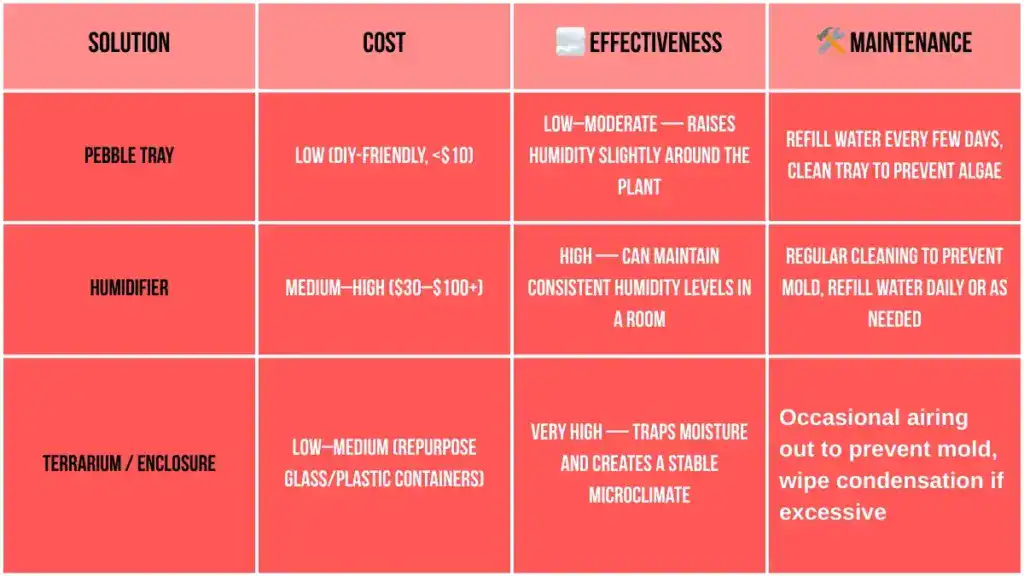
A pebble tray is exactly what it sounds like: a shallow tray filled with pebbles and water, placed under a plant. The water evaporates slowly around the plant, creating a tiny pocket of higher humidity.
How I tested it:
I placed a digital hygrometer 10 cm above a pebble tray under my peace lily. The room humidity was 38%. The reading above the tray? 44%.
Then I moved the sensor 30 cm away. The reading dropped back to 38%.
What this means: A pebble tray helps the plant directly above it, not the entire room. Use one tray per humidity-loving plant, and don’t expect it to fix a room-wide dryness problem.
My personal rule: I keep a pebble tray under my Calathea and my peace lily. They’re cheap, require no electricity, and they work—for those two plants.
Method 2: Grouping Plants Together (The Accidental Discovery)
This one surprised me.
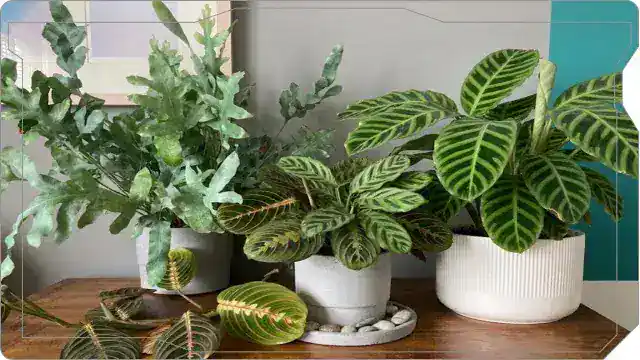
I used to arrange my plants based on how they looked. Then, one dry winter week, I ran out of space and grouped my Calathea, Monstera, and Philodendron together on one shelf.
Curious, I placed my hygrometer in the middle of the group.
The reading jumped from 38% to 46% in one week.
Why this works: Plants release water vapor through transpiration. When you group them, they create a shared microclimate—each plant benefits from the moisture released by its neighbors.
How I do it now: I keep all my humidity-loving plants together on one shelf unit. It’s not Instagram-perfect spacing, but the collective humidity is the highest I’ve ever measured without a machine.
Method 3: A Real Humidifier (The Only Thing That Solves Room-Wide Dryness)
If you have multiple humidity-loving plants, or your indoor air is extremely dry in winter, a humidifier is the only solution that works at scale.
I tested five humidifiers before finding one I’d recommend.
What to avoid: Don’t buy those tiny, decorative USB humidifiers shaped like animals or plants. They barely output enough mist to cover a single plant, let alone a room. I tried three different ones from Amazon. They all ended up in a drawer.
What I use now: I settled on the LEVOIT LV600S Smart Warm and Cool Mist Humidifier. It’s not cheap, but it covers 70 square meters, runs for 24+ hours on one fill, and has a built-in humidistat so it automatically maintains your target humidity.
My setup: I run it only in winter, when indoor humidity drops below 35%. The rest of the year, grouping and pebble trays do the job.
A Quick Note on Bathrooms and Terrariums
Some advice tells you to move your plants to the bathroom for “humidity from showers.” I tried this. Here’s the problem: bathroom humidity spikes and then drops rapidly once the door opens. It’s not stable. Most bathrooms also have poor light. This method annoyed me more than it helped.
Terrariums and glass cabinets (like the IKEA greenhouse cabinet trend) work wonderfully but require a completely different setup and maintenance routine. I cover those in detail in my Rare Plants Care guide.
How to Know If Your Plant Needs More Humidity
Over the years, I’ve learned to read the signs before my plants hit crisis mode:
- Curled, crispy leaf edges: Classic low-humidity signal, especially on Calathea, prayer plants, and ferns.
- Brown tips on new leaves: New growth is the most sensitive. If emerging leaves turn brown at the tips before unfurling, the air is too dry.
- Leaves that feel dry and papery: Healthy tropical leaves should feel slightly cool and supple. If they feel like paper, humidity is too low.
- Constant dropping of lower leaves: Some leaf drop is normal. But if your plant is shedding more than usual, low humidity could be the silent cause.
My Final System (After 3 Years of Testing)
Here’s the simple system I follow today:
- Summer: I group all humidity-lovers together. No humidifier needed.
- Winter: I run my humidifier in the plant corner, set to maintain 50%. I keep two pebble trays under my most sensitive plants.
- Year-round: I don’t mist. I don’t move plants to the bathroom. I don’t overcomplicate things.
The result? My Calathea hasn’t curled a single leaf in 18 months. My Monstera puts out larger, more fenestrated leaves every season. My peace lily blooms repeatedly.
What About You?
What’s your biggest humidity struggle? Drop a comment below—I read every single one. If you found this guide helpful, grab my Snake Plant Care Guide with the exact watering and humidity ranges I use for my snake plants.