
Best Plants for Bathroom: 10 Houseplants That Actually Work
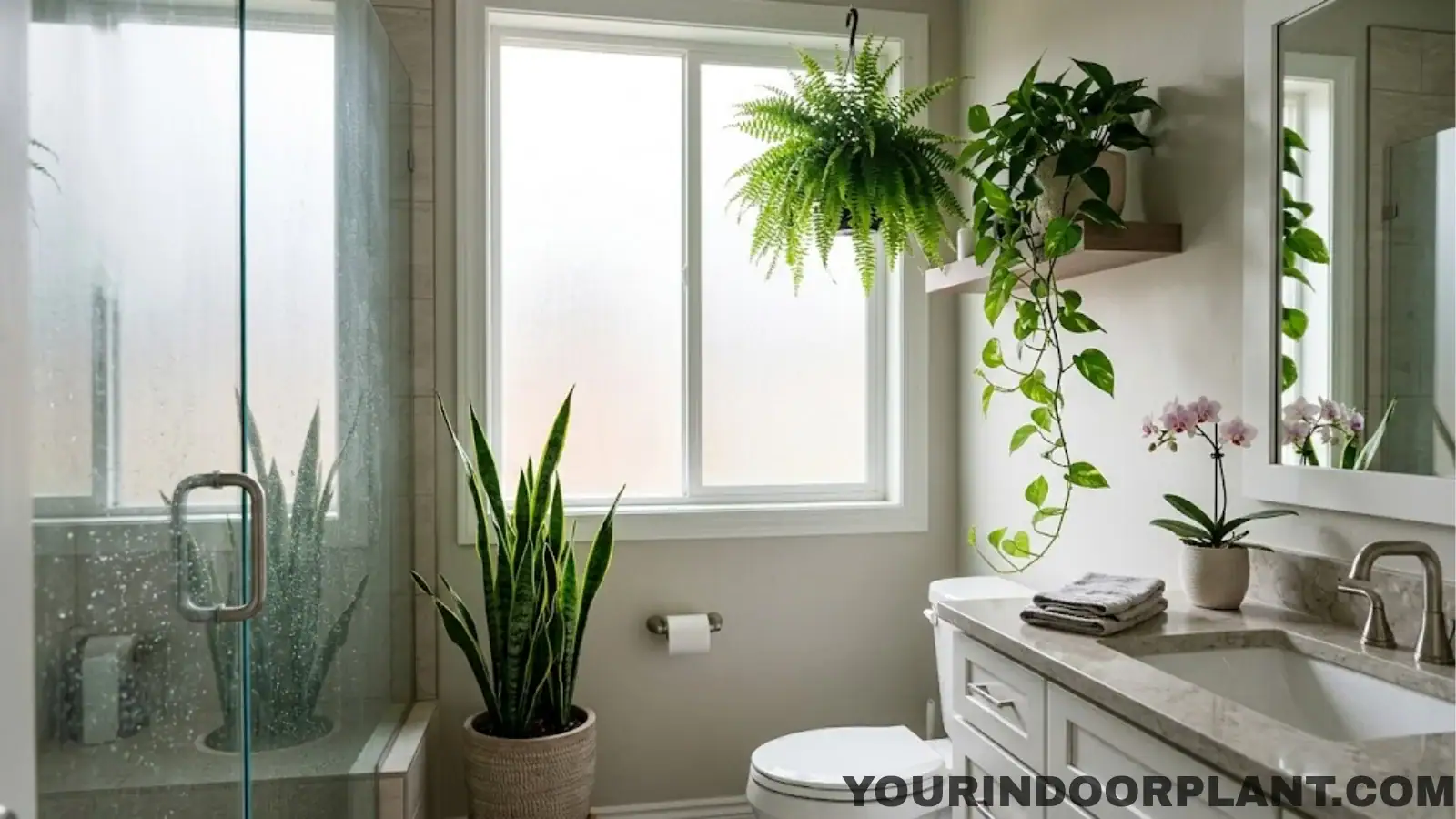
The best bathroom plants are not simply plants that “love humidity.” They are plants that can handle the combination of light, humidity, temperature, and watering conditions in your particular bathroom.
That distinction matters.
A bright bathroom with a window can support very different plants from a bathroom with no natural light. And while shower steam can increase humidity temporarily, it cannot compensate for a room that is too dark for a plant to photosynthesize.
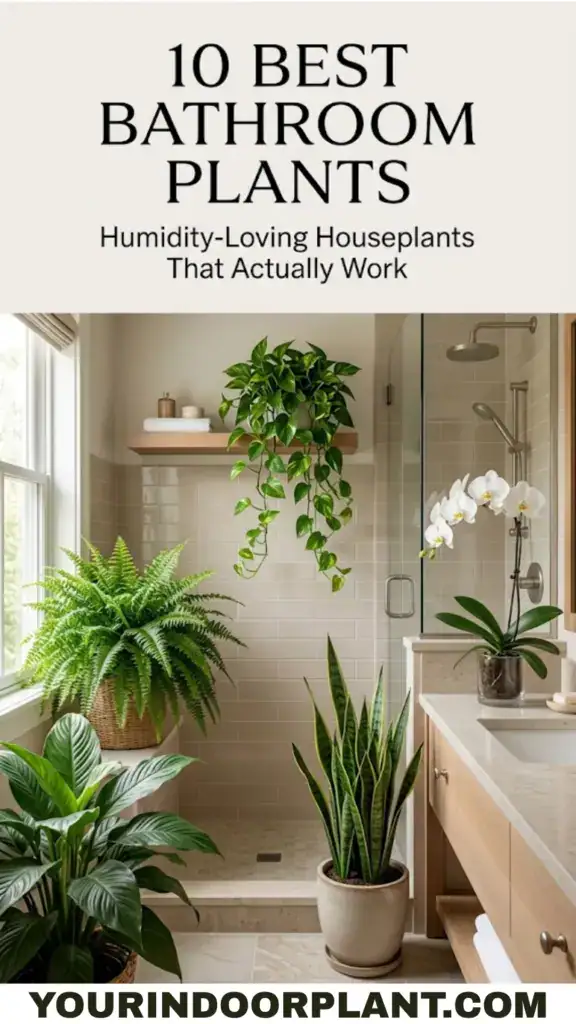
For most bathrooms, reliable choices include pothos, snake plants, spider plants, peace lilies, Boston ferns, ZZ plants, and Phalaenopsis orchids—but the right choice depends heavily on available light.
Here is how I would approach choosing a bathroom plant before buying anything.
First, Check Your Bathroom’s Light
Light should be your first consideration—not humidity.
This is the mistake I see most often with bathroom plants. A bathroom may feel wonderfully humid after a shower, but if it has no usable natural light, that humidity doesn’t make it suitable for a sun-loving plant.
A simple way to think about it:
| Bathroom condition | Plants to consider |
|---|---|
| Bright indirect light | Orchid, spider plant, pothos, peace lily |
| Medium light | Pothos, spider plant, peace lily, snake plant |
| Low natural light | Snake plant, ZZ plant, pothos |
| Completely windowless | No plant can thrive indefinitely without supplemental light |
If your bathroom has a window, observe the quality of the light rather than simply labeling it “bright.”
A window with several hours of strong direct afternoon sun is very different from a frosted window facing north.
And remember that plants described as “low-light tolerant” are not plants that require no light. They simply tolerate less light than many other houseplants.
1. Pothos
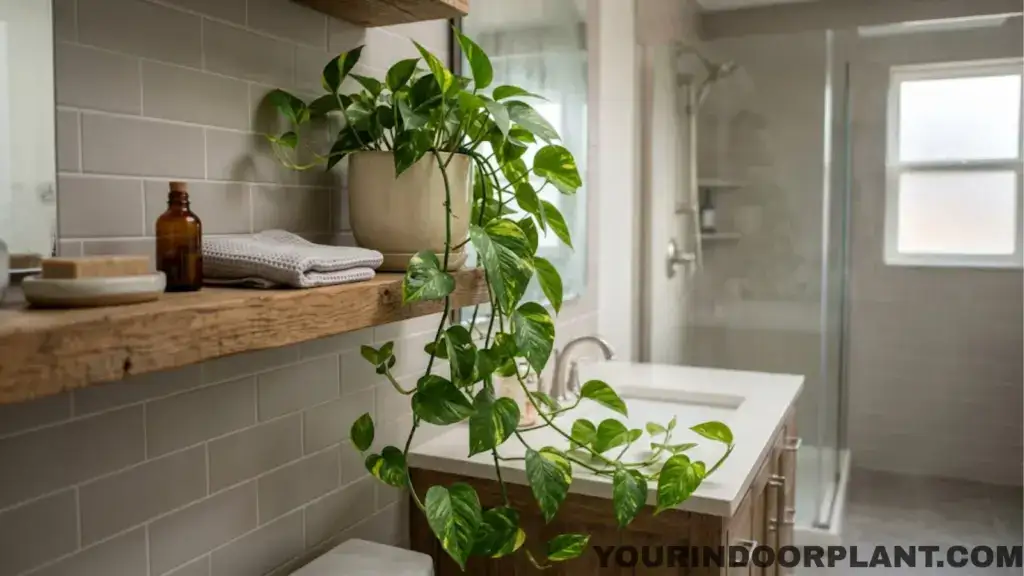
Pothos is one of the best all-around bathroom plants because it combines adaptability, attractive trailing growth, and relatively forgiving care.
Pothos can work particularly well on a bathroom shelf, cabinet, or hanging planter where its vines can eventually cascade downward.
Golden pothos, marble queen pothos, and neon pothos can all be attractive choices. However, there is an important difference between them.
Variegated pothos generally needs better light to maintain strong variegation. In a darker bathroom, you may notice new growth becoming greener.
- Best placement: Place pothos near a window where it receives bright or moderate indirect light. Avoid putting the plant directly beside the shower where water repeatedly splashes onto the foliage and soil.
- Watch for: If the soil remains wet for long periods, move the plant to a brighter location and reassess your watering habits rather than assuming the bathroom humidity means it needs more water.
2. Snake Plant
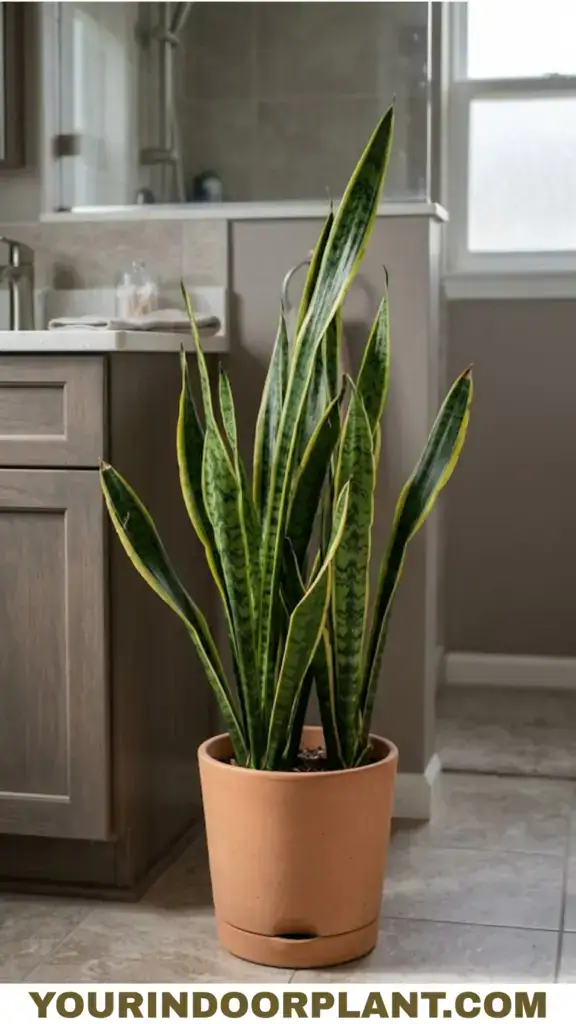
Snake plants are among the safest choices for bathrooms where natural light is limited.
The plant formerly known botanically as Sansevieria trifasciata is now classified as Dracaena trifasciata. Its upright growth makes it particularly useful when you don’t have much shelf space.
A snake plant also doesn’t need consistently damp soil. In fact, keeping its roots wet is one of the easiest ways to create problems.
Best placement:
Try:
- Beside a bathroom cabinet
- In an empty corner
- Near a window with indirect light
- On the floor beside a vanity
Important care tip:
- Don’t water it simply because you’ve had a long, steamy shower.
- Check the potting mix first.
- Humidity in the air and moisture in the soil are two different things.
3. Spider Plant
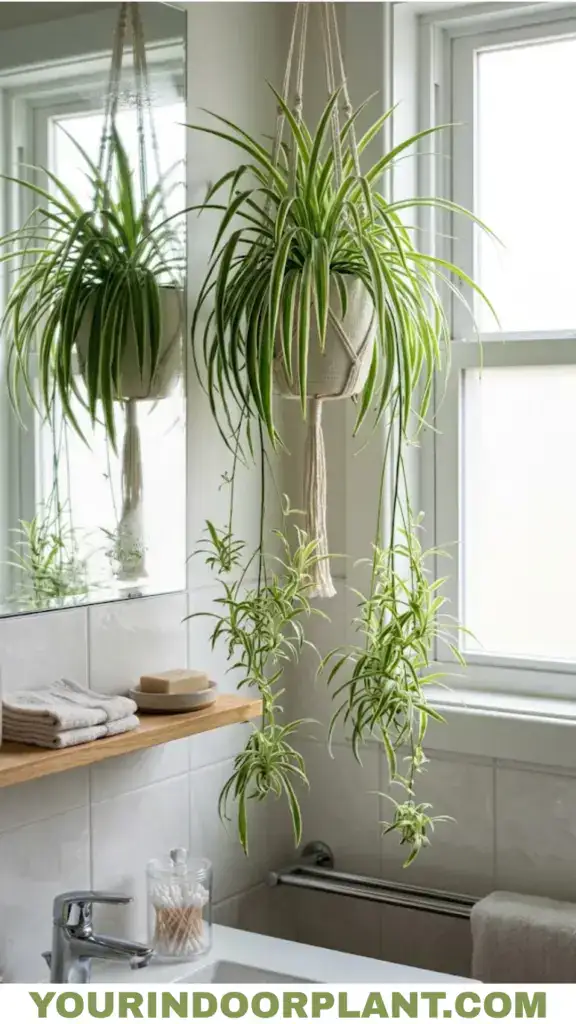
Spider plants are excellent bathroom choices when you want something that grows quickly and produces a naturally cascading appearance.
Their arching leaves and small plantlets make them particularly attractive in hanging baskets or on high shelves.
They are also adaptable enough for many ordinary indoor environments. A bathroom with moderate indirect light can be a particularly good location.
Best placement:
- A shelf near a window or a hanging planter where the offsets can develop freely works well.
- Avoid putting the plant where its foliage is constantly brushed against or soaked.
4. Peace Lily
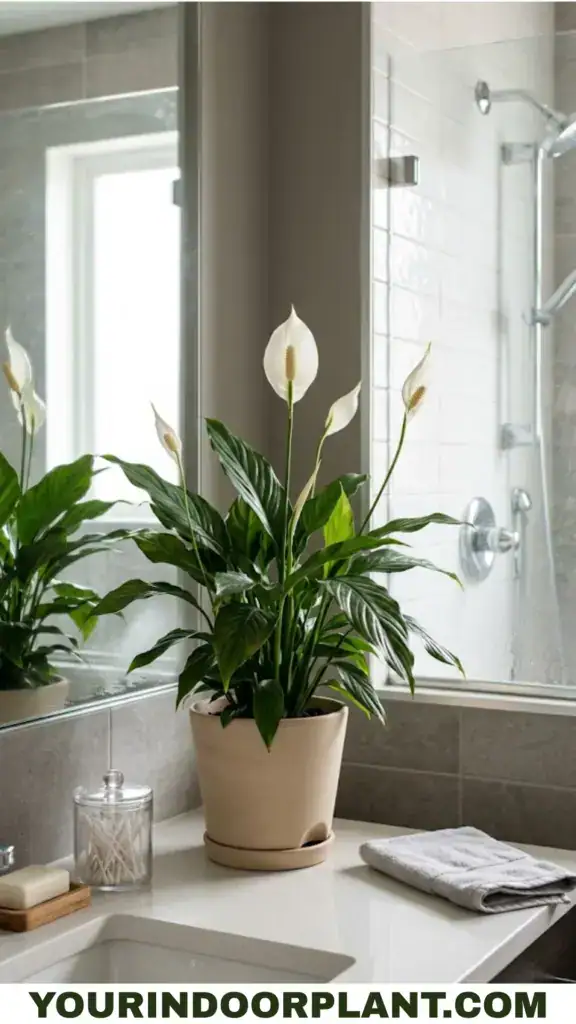
Peace lilies are a good choice for bathrooms with moderate light and higher humidity, but they should not be treated as plants that can survive indefinitely in darkness.
Peace lilies have broad green leaves and distinctive white spathes, making them useful when you want a bathroom plant that feels more substantial.
They also have a useful visual signal: when they become significantly droopy, the plant may be telling you that the root ball has become too dry.
That doesn’t mean you should wait for dramatic wilting every time before watering. Instead, use the plant’s condition alongside a check of the potting mix.
Best placement:
- Bright to moderate indirect light is preferable.
- Keep the plant away from cold drafts and direct blasts of hot air.
5. Boston Fern
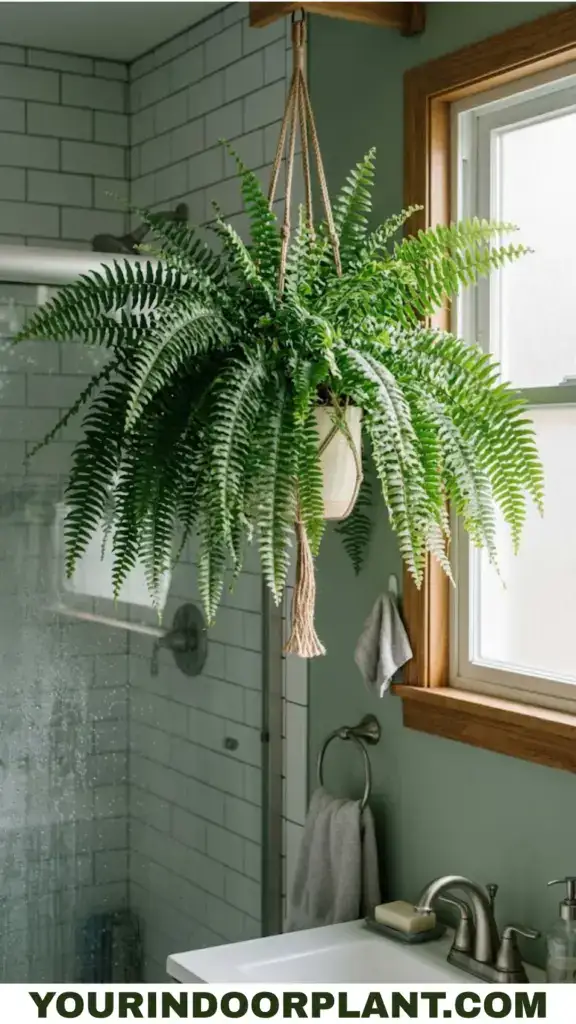
Boston ferns are one of the best choices for a genuinely humid bathroom—but they are also considerably less forgiving about watering. This is where many bathroom plant lists become misleading.
A fern may love humid air, but that does not mean it wants its pot sitting in permanently saturated soil.
Boston ferns generally perform best when their growing medium stays evenly moist without becoming waterlogged.
Best placement:
- A bright bathroom with indirect light is ideal.
- A hanging basket can work beautifully because the soft foliage naturally spills over the sides.
If your bathroom is dry:
A bathroom that is only occasionally humid may not provide enough consistent humidity for a Boston fern to look its best.
In that situation, grouping plants together or using another humidity-management approach can help. University of Minnesota Extension notes that grouping houseplants can create a small humid microenvironment around them.
6. ZZ Plant
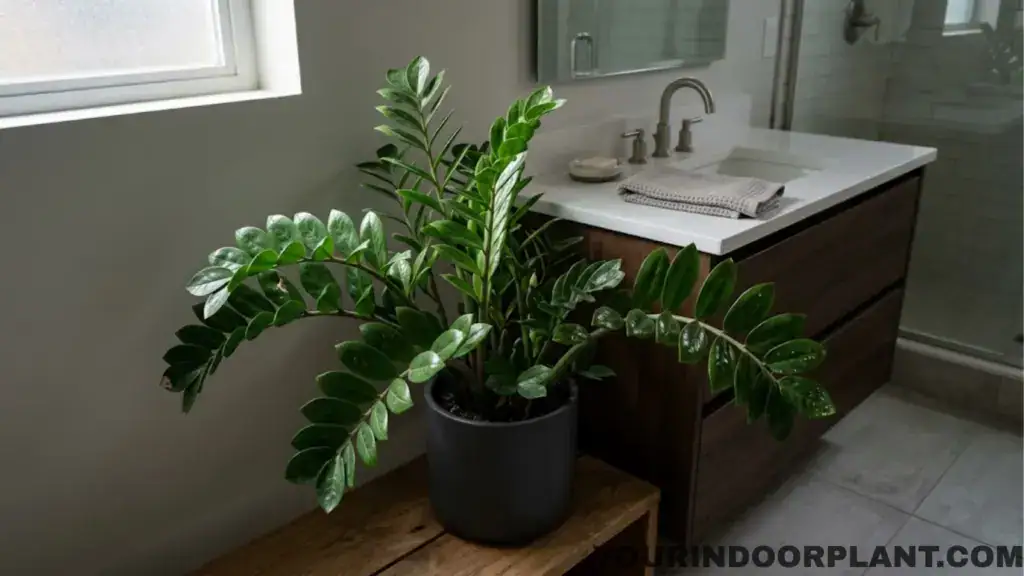
A ZZ plant is useful for bathrooms where light is limited and watering needs to be infrequent.
Its thick underground rhizomes allow it to tolerate periods of dryness better than many moisture-loving plants.
That makes it a practical option for a bathroom that isn’t particularly humid despite occasional showers. But there is a misconception worth clearing up:
A ZZ plant is low-light tolerant, not light-independent.
If your bathroom has absolutely no natural light, the long-term solution is supplemental grow lighting rather than hoping the plant will live on bathroom humidity.
7. Phalaenopsis Orchid
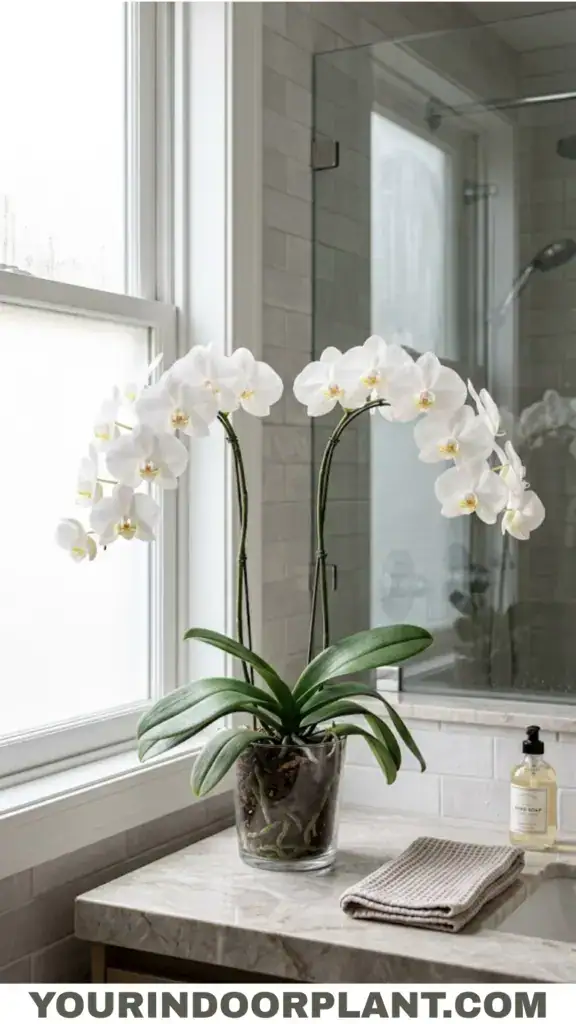
A Phalaenopsis orchid can be an excellent bathroom plant when the room has a bright window and you can provide appropriate orchid care.
The humidity created by normal bathroom use can be helpful, but light remains critical.
Orchids are not ideal for a dark bathroom simply because the room gets steamy.
- Place the orchid near a bright window with filtered or indirect light.
- Avoid leaving the pot sitting in water, and make sure excess water can drain freely.
8. Peperomia
Peperomia is a strong choice for a smaller bathroom with moderate to bright indirect light.
Many peperomias remain relatively compact, which makes them useful when you don’t have room for a large floor plant.
Their thicker leaves also mean they generally don’t require the same consistently moist conditions as a fern.
Allow the potting mix to dry appropriately between waterings rather than following a fixed weekly schedule.
9. Fittonia
Fittonia is particularly attractive in humid bathrooms when you can provide bright, indirect light and consistently moist—but well-drained—soil.
Its colorful veined leaves make it a good choice when you want something smaller and more decorative.
University of Minnesota Extension specifically identifies Fittonia albivenis as a plant that can work well in bathrooms and notes its preference for bright, indirect light, moisture, and high humidity.
Fittonia can wilt dramatically when it becomes too dry, but repeated cycles of severe drying and saturation are not a good substitute for consistent care.
10. Calathea
Calatheas can work in humid bathrooms, but I would not put them on the “easy bathroom plant” list.
They are much more sensitive to inconsistent moisture, dry air, temperature changes, and water quality than tougher plants such as pothos or snake plants.
- If your bathroom provides stable conditions and good indirect light, they can be beautiful.
- If you’re a beginner looking for something forgiving, start with pothos or snake plant instead.
Best Bathroom Plants by Condition
Rather than asking “What is the best bathroom plant?”, match the plant to your room.
1) Best plants for a low-light bathroom
Choose:
- Snake plant
- ZZ plant
- Pothos
These are among the more forgiving options, although they still require usable light.
2) Best plants for a bright bathroom
Choose:
- Phalaenopsis orchid
- Spider plant
- Pothos
- Peace lily
- Peperomia
- Fittonia
3) Best plants for a humid bathroom
Choose:
- Boston fern
- Fittonia
- Peace lily
- Calathea
- Orchid
But remember: high humidity does not eliminate the need for proper drainage and appropriate light.
Can Plants Live in a Windowless Bathroom?
Not indefinitely without supplemental lighting. This is probably the most important correction to the typical “best bathroom plants” list.
You will often see snake plants and ZZ plants recommended for windowless bathrooms. They can tolerate low-light conditions better than many houseplants, but a completely dark room does not provide the light required for normal photosynthesis.
If you have a bathroom with no window, you have three practical choices:
- Use a suitable grow light.
- Rotate plants between the bathroom and a brighter location.
- Use artificial plants for decoration.
If you want a living plant to remain permanently in the bathroom, supplemental lighting is the most reliable solution.
Where Should You Put Bathroom Plants?
Put the plant where it receives enough light while staying away from constant water splashes. Good locations include:
- A bright windowsill
- A shelf near a window
- A bathroom cabinet with adequate light
- A hanging planter
- A corner receiving indirect daylight
Avoid:
- Direct shower spray
- Constantly wet countertops
- Cold drafts
- Direct contact with heating appliances
- Locations where leaves remain wet for long periods
A plant does not become healthier simply because it is closer to the shower.
Should You Water Bathroom Plants Less Often?
Not automatically. Bathroom humidity can slow the rate at which some plants lose moisture, but watering frequency still depends on the plant, pot size, soil mix, temperature, airflow, and light.
Instead of using a calendar, check the growing medium. For example, a snake plant in a dim bathroom may remain wet for considerably longer than the same plant sitting beside a bright window. That’s why “water every Sunday” advice is unreliable.
Do Bathroom Plants Actually Need Humidity?
Some do, but humidity is only one part of the growing environment.
Plants such as Boston fern and Fittonia benefit much more from humid conditions than drought-tolerant plants such as snake plant and ZZ plant.
If your bathroom is naturally humid, take advantage of it. If it isn’t, don’t automatically compensate by misting leaves several times a day. Improving the overall environment is generally more useful than repeatedly wetting foliage.
Common Bathroom Plant Mistakes
The biggest mistakes are surprisingly simple:
- Choosing a plant because it “likes humidity” without checking light: Humidity cannot replace light.
- Keeping the soil constantly wet: High humidity does not mean roots should remain saturated.
- Putting plants directly in the shower: Repeated splashing can disturb soil, increase disease problems, and make drainage more difficult to manage.
- Using decorative pots without drainage: A beautiful bathroom container is not worth sacrificing root health.
- Ignoring seasonal changes: Your bathroom may be warmer and more humid during winter showers but considerably drier when the heating system is running.
Final Thoughts
The best plants for bathrooms are not necessarily the plants that love humidity the most. The best plant is the one whose light, watering, and humidity requirements match the bathroom you actually have.
For a low-light bathroom, start with pothos, snake plant, or ZZ plant. For a bright, humid bathroom, you can expand into orchids, ferns, Fittonia, and other more demanding plants.
And if your bathroom has no window at all, don’t let a plant list convince you that darkness is enough. Add a grow light or choose faux greenery instead.
For more ways to use plants throughout your home, see our indoor plant decor ideas, or learn how to use trailing plants with our guide to the best hanging plants for indoors.