
10 Snake Plant Benefits: Why It’s the Perfect Houseplant

🌿 Quick Answer: Is a Snake Plant Good for Your House?
Yes. The snake plant is one of the most beneficial houseplants you can own. Its primary benefits include producing oxygen at night (unlike most plants), filtering harmful indoor toxins like formaldehyde and benzene, reducing respiratory allergens, and being incredibly low-maintenance. Because it thrives in low light and requires minimal watering, it is the #1 recommended plant for bedrooms and beginners.
📊 Summary of Benefits at a Glance
| Benefit Category | Specific Effect | Why It Matters |
|---|---|---|
| Air Quality | Nighttime Oxygen Production | Improves sleep quality in bedrooms |
| Health | Filters VOCs (Formaldehyde, etc.) | Reduces “Sick Building Syndrome” |
| Allergies | Dust & Airborne Particle Reduction | Cleaner air for asthma/allergy sufferers |
| Maintenance | Drought Tolerant / Low Light | Perfect for “black thumbs” and travelers |
| Mental Health | Stress Reduction | Biophilic design lowers cortisol levels |
| Spiritual | Feng Shui “Protective Energy” | Guards the home against “negative chi” |
1. It Produces Oxygen at Night (The Bedroom Hook)
Most plants take in CO2 and release oxygen during the day (photosynthesis) but flip the process at night. The snake plant is different.
It uses Crassulacean Acid Metabolism (CAM). It keeps its pores (stomata) closed during the day to save water and opens them at night to take in CO2 and release oxygen.
My Experience: I have three large Laurentii in my bedroom in Portland. While one plant won’t replace a window, the psychological and physical boost of fresh oxygen while sleeping is why I consider this the ultimate bedroom plant.
2. NASA-Proven Air Purification (The Reality Check)
You’ve likely heard about the NASA Clean Air Study. It proved that snake plants can remove toxins like formaldehyde, xylene, toluene, and benzene from the air. These toxins are found in everyday items like carpets, paint, and cleaning supplies.
The Honest Truth: To see a laboratory-level difference in a standard living room, you would need about 6–8 tall plants. However, even one or two plants contribute to a cleaner “micro-climate” around your desk or bed. It’s a natural, silent air filter that never needs a filter change.
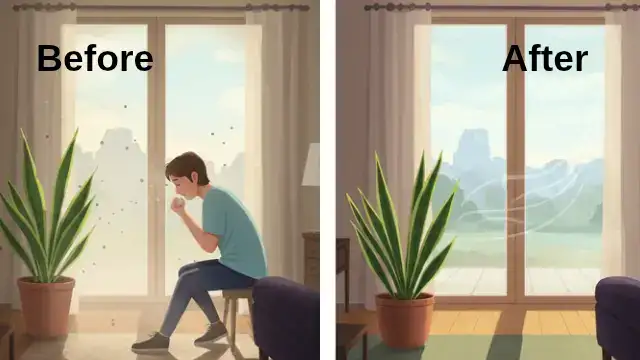
3. It Filters Out Household Allergens
By releasing moisture into the air and reducing airborne nitrates, snake plants can help reduce the impact of airborne allergens like dust and dander. If you suffer from seasonal allergies or hay fever, having a collection of snake plant varieties near your windows can act as a secondary defense line.
4. Mental Health & “Biophilic” Stress Relief
Studies in the Journal of Physiological Anthropology found that active interaction with indoor plants (like the simple task of repotting) can reduce physiological and psychological stress.
There is something deeply grounding about the architectural, “sword-like” shape of the snake plant. It provides a sense of structure and “living decor” that plastic plants simply can’t match.
5. Protective Energy (Feng Shui Benefits)
In Feng Shui, the snake plant is often called the “Sword of Zhou.” Because the leaves grow upward and are pointed, they are believed to provide protective energy.
Where to place it:
- Near the entrance: To guard against negative energy entering the house.
- In the office: To improve focus and cut through “mental clutter.”
- Avoid: High-traffic narrow hallways where the “sharp” energy might feel aggressive.
6. It Is Nearly “Unkillable” (Reduced Owner Stress)
The biggest benefit for many of my readers? It doesn’t die easily.
- It handles low light conditions better than 90% of other plants.
- It only needs water every 2–6 weeks.
- It doesn’t attract many pests.
For a busy professional or a frequent traveler, the benefit is peace of mind. You don’t have to worry about your plant dying while you’re on a week-long trip.
7. It Regulates Humidity
Through a process called transpiration, snake plants release moisture into the air. In dry winter months (especially here in Portland when the heater is on), this can help keep the indoor humidity from dropping too low, which is better for your skin and respiratory health.
8. Natural Sound Absorption
While one small plant won’t soundproof a room, the thick, fleshy leaves of a large snake plant (or a row of them) can help diffuse sound waves. If you have a room with “echoey” hard floors, a few tall Laurentii in the corners can soften the acoustics of the space.
9. It’s the “Gift That Keeps Giving”
One of the best benefits is how easy it is to propagate. One healthy mother plant can produce dozens of “pups” over its lifetime.
- You get free plants for other rooms.
- You have a steady supply of eco-friendly, meaningful gifts for friends.
10. Versatile Decor for 2026 Trends
In 2026, interior design is moving toward “Organic Modernism.” The snake plant fits this perfectly. Whether you have a mid-century modern planter or a rustic terracotta pot, the snake plant’s vertical lines provide a high-end look without the high-end maintenance.
⚠️ A Note on Safety: Is it Toxic?
While the benefits are many, there is one drawback: Snake plants are toxic to pets. They contain saponins which can cause nausea and vomiting in cats and dogs.
My Advice: Always keep them on elevated stands or in rooms where pets don’t have unsupervised access. Read my full safety guide for pet owners before buying.

📋 Don’t Rate These!
- Want these benefits? Start with my Snake Plant Care Made Simple guide.
- Ready to buy? Check out the 16 best varieties for your home.
- Seeing a problem? Here is how to fix drooping leaves.
- Spring Maintenance: Don’t forget my 5-step repotting guide.
Frequently Asked Questions (FAQ)
Is it good to have a snake plant in the bedroom?
Yes, it is one of the best bedroom plants because it produces oxygen at night and filters indoor toxins, which may help improve sleep quality.
Does a snake plant really purify the air?
Yes, it filters toxins like formaldehyde and benzene. However, for significant room-wide purification, you should have multiple plants.
Can a snake plant live in a bathroom with no windows?
It can survive for a while because it is very hardy, but it will eventually struggle without any light. It’s better to rotate it into a lit room every week or use a small grow light.
Does the snake plant reduce CO2?
Yes, through CAM photosynthesis, it absorbs CO2 at night, which is the opposite of most other houseplants.
Snake plant benefits for office?
Low light tolerance + focus boost (20% stress reduction). Dust trapping ideal for workspaces.