
Monstera Obliqua vs Adansonii: 7 Key Differences (And Why You’re Probably Buying the Wrong One)
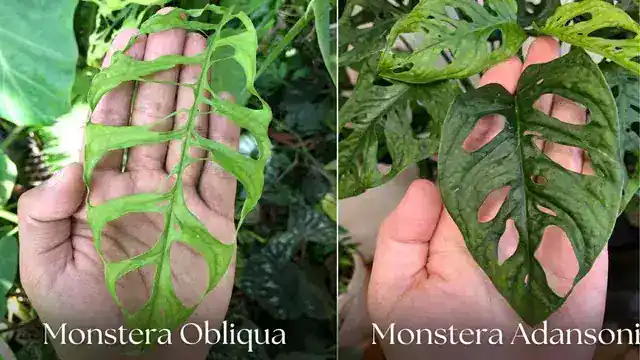
Let me say this upfront, because no one else will: if you bought a “Monstera obliqua” from a nursery, a plant shop, or most online sellers, you almost certainly have a Monstera adansonii.
That’s not an insult. Adansonii is a genuinely beautiful plant. But the confusion between these two species is so widespread — and sometimes so deliberately exploited — that I’ve seen plant parents spend $50, $100, even $200 on what they believed was obliqua, only to realize months later that their “rare” plant was growing like wildfire. Obliqua doesn’t grow like wildfire. Obliqua barely grows at all.
I’ve been growing Monsteras for over a decade, and I’ve handled both species. The differences are real, they’re specific, and once you know them, you can’t unsee them. This guide covers all seven — plus a bonus difference most articles miss — so you can evaluate any plant honestly before spending serious money.
🌿 Quick Answer: How to Tell Monstera Obliqua from Adansonii
The fastest three-point check:
Leaves: If the leaf feels thick and leathery → adansonii. Paper-thin and almost transparent → possible obliqua.
Growth rate: If your plant pushes new leaves regularly and has grown significantly in under a year → adansonii. No exceptions.
Price: If the price didn’t make you genuinely nervous → adansonii. Verified obliqua starts at $500+ for a rooted cutting.
The plant community’s running joke says it best: “It’s never obliqua.” And they’re almost always right.
Why Does This Confusion Exist in the First Place?
When both plants are young — juvenile stages, first few months of growth — they look nearly identical. Both have oval-shaped leaves with fenestrations (holes). Both climb. Both belong to the same genus and family (Araceae). And because true Monstera obliqua is so rarely seen in cultivation, most sellers and buyers have never actually seen a mature one.
The result: adansonii gets labeled and sold as obliqua constantly. Sometimes by accident. Sometimes not.
The confusion runs so deep in plant communities that Instagram collector Mick Mittermeier launched the hashtag #itsneverobliqua — a running joke that captures how reliably misidentified this plant is. If you search that hashtag, you’ll find thousands of adansonii plants confidently labeled as obliqua by their owners.
True Monstera obliqua (specifically the Peruvian form, Monstera obliqua sp. Peru, which is the most commonly referenced) is so rare in cultivation that it’s primarily passed between private collectors and botanical institutions. You will not find it at your local garden center. You will not find it on most Etsy shops. And if the price isn’t making you slightly nervous, it’s not obliqua.
“One important nuance before we start: When people say “obliqua” in plant communities, they almost always mean the Peru form — the one with extreme fenestration. But Monstera obliqua actually has four geographical forms: Peru, Panama, Suriname, and Bolivia. Most forms of obliqua don’t even have significant fenestration. The Peru form is the one in cultivation and the one this article compares to adansonii.”
The 7 Differences Between Monstera Obliqua and Adansonii
Difference 1: Fenestrations (Holes) — The Most Visible Difference
This is the one everyone notices first — and it’s the most dramatic difference between the two plants.
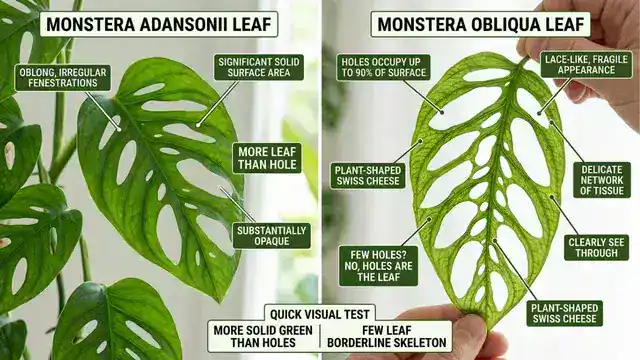
Monstera adansonii has fenestrations that are oblong, narrow, and irregularly sized. The holes are scattered across the leaf, but the leaf itself retains significant solid surface area. At maturity, adansonii is clearly more leaf than hole.
Monstera obliqua (Peru form) takes fenestrations to an extreme that seems almost unnatural. On mature leaves, the holes occupy up to 90% of the leaf surface, leaving only a delicate network of green tissue holding everything together. The leaf looks more like lace or a skeleton than a solid leaf. The fenestrations are rounder and larger relative to the leaf size, and the overall effect is so dramatic that it genuinely looks fragile — because it is.
If you hold a mature obliqua leaf up to the light, you can see through it clearly. An adansonii leaf, even heavily fenestrated, remains substantially opaque.
Quick visual test: If your plant’s leaves are clearly more solid green than holes, you have adansonii. If you’re looking at something that resembles plant-shaped Swiss cheese with barely any leaf left, that’s the Peru form of obliqua.
| Plant | Adansonii | Obliqua (Peru form) |
|---|---|---|
| Hole shape | Oblong, elongated | Rounder, more circular |
| Hole coverage | 30–50% of leaf | Up to 90% of leaf |
| Visual effect | More leaf than hole | More hole than leaf |
| Against light | Mostly opaque | Nearly translucent |
Difference 2: Leaf Thickness and Texture — Paper vs. Leather
This difference is immediately obvious when you handle both plants, but almost impossible to convey in photos — which is why sellers get away with the misidentification online.
Monstera adansonii leaves are noticeably thick and have a slightly rough, leathery texture. They feel substantial in your hand. The surface has a subtle matte or waxy finish. These leaves are sturdy enough to handle casual touching without damage.
Monstera obliqua leaves are paper-thin. Not “thin for a plant” — genuinely paper-thin, almost transparent when held to light. The texture is extremely soft and delicate. A slight breeze can move them. Touching them carelessly can cause damage. This extreme delicacy is one of the main reasons obliqua is considered so difficult to cultivate — the leaves are damaged by dry air, drafts, direct light, and rough handling.
The one-touch test: If your “obliqua” feels like a sturdy houseplant leaf, you have adansonii.
Difference 3: Leaf Edges — Wavy vs. Straight
A subtler difference, but reliable when comparing plants side by side.
Monstera adansonii leaves have edges that are relatively straight and firm. The margin holds its shape cleanly.
Monstera obliqua leaves have noticeably wavy, slightly irregular edges. This waviness is particularly visible along the outer margin and contributes to the overall delicate, undulating appearance of the plant.
This isn’t the most reliable single identifier — but combined with the others, it forms a consistent pattern.
Difference 4: Leaf and Plant Size — Small vs. Smaller
Here’s something counterintuitive: obliqua is actually smaller than adansonii — despite being considered the more “impressive” plant.
Monstera adansonii leaves in maturity can reach 50–75 cm (20–30 inches) in length. The plant itself is a vigorous climber that, given a moss pole and proper conditions, can grow quite large and full.
Monstera obliqua (Peru form) produces leaves that rarely exceed 10–25 cm (4–10 inches) even at full maturity. As botanist Michael Madison documented in his 1977 revision of Monstera, obliqua is among the smallest species in the genus. The stems are 2–10mm thick. The overall plant, even fully mature, stays quite small.
If you have a fast-growing, large-leafed plant that someone told you is obliqua, the size alone is nearly definitive.
Difference 5: Stolons — The Feature That Settles It
This is the most definitive botanical difference between the two species, and the one experts use to confirm obliqua identity with certainty when the plant is actively growing.
Monstera adansonii does not produce stolons. It grows in a standard vining pattern, sending out stems with leaves and aerial roots.
Monstera obliqua produces stolons — long, leafless runners that extend outward from the plant, sometimes dramatically. In their natural habitat, these stolons can grow up to 60 feet, seeking anchor points on trees before sending up a new growth point. Indoors, you’ll see them as thin, leafless stems reaching out with no obvious destination.
If your plant has never produced a leafless runner extending outward from the base, and it’s been growing for more than a year, this is strong evidence it’s adansonii.
The stolon difference is also why obliqua behaves so strangely in cultivation — it’s not trying to grow upward in a conventional sense. It’s exploring, seeking new surfaces to colonize. This makes it genuinely unusual to grow in a pot. Interestingly, these stolons are also the primary propagation method for obliqua: nodes along the stolon can be pinned to damp sphagnum moss to produce new plants.
Difference 6: Growth Rate — Fast vs. Glacial
This is often the first difference plant parents notice after bringing home what they thought was obliqua.
Monstera adansonii grows fast. Under good conditions — bright indirect light, adequate humidity, regular watering — adansonii pushes out new leaves regularly. It’s one of the faster-growing Monsteras and can become quite large within a year or two of good care.
Monstera obliqua grows painfully slowly. Even in its natural habitat — tropical rainforests with ideal humidity, temperature, and light — obliqua takes years to climb a couple of feet. In cultivation, new leaves may appear only a few times per year, and each one is a small event for the grower.
This growth rate difference is actually part of why obliqua is so rare: there simply aren’t many plants in circulation because propagating them takes so long and is so difficult.
If your plant is growing rapidly and pushing new leaves every few weeks, you have adansonii. No exceptions.
Difference 7: Price — The Most Honest Indicator
Let me be direct here, because this matters practically.
Monstera adansonii costs $15–$60 for a healthy potted plant from most nurseries and online sellers. It’s widely available, easy to source, and you can find it at many garden centers.
Monstera obliqua — a real, verified specimen — costs dramatically more. We’re talking $500–$3,000 for a rooted cutting, and prices can go far higher for established plants or rare forms. A mature Peruvian obliqua has sold for $23,000. During the peak of the rare plant boom in 2020–2021, specimens were changing hands at £15,000 internationally.
As of 2026, prices have moderated somewhat as the rare plant market has cooled. But a listing showing “Monstera obliqua” for $20–$50 is almost certainly adansonii. If the seller can’t provide detailed provenance, collector lineage, or documentation of the plant’s origin — and the price is under $300 for any rooted specimen — treat it as adansonii until proven otherwise.
The price alone doesn’t prove authenticity. But it’s a reliable filter. Nobody is selling verified obliqua for $25.
Bonus Difference 8: Flowers — The Definitive Scientific Identifier
Most articles on this topic stop at seven differences. Here’s one they miss.
When either plant flowers (which is rare indoors), the inflorescences are measurably different. Obliqua produces significantly fewer flowers on the spadix than adansonii, and the seeds (berries) appear later. This is one of the most botanically certain ways to distinguish the two species — but realistically, most of us will never see either plant flower indoors, making it the least practical test despite being the most scientifically definitive.
It’s worth knowing exists, even if you’ll never use it.
Complete Side-by-Side Comparison
| Feature | Monstera Adansonii | Monstera Obliqua (Peru) |
|---|---|---|
| Fenestrations | Oblong holes, 30–50% of leaf surface | Round, extreme holes — up to 90% of leaf |
| Leaf texture | Thick, slightly rough, leathery | Paper-thin, soft, almost transparent |
| Leaf edges | Straight, firm margins | Wavy, irregular |
| Mature leaf size | 50–75 cm (20–30 inches) | 10–25 cm (4–10 inches) |
| Stolons | ❌ None | ✅ Produces leafless runners |
| Growth rate | Fast — new leaves regularly | Glacial — a few leaves per year |
| Flowers | More flowers on spadix | Fewer flowers, later seeds |
| Where to buy | Nurseries, garden centers, most online shops | Private collectors, botanical institutions only |
| Typical price (rooted) | $15–$60 | $500–$3,000+ |
| Difficulty to grow | Beginner-friendly | Expert — needs 80%+ humidity, terrarium conditions |
Care Comparison: How to Grow the One You Actually Have
Most readers who reach this article own an adansonii. Here’s exactly how to care for it — and what obliqua demands if you’re pursuing the real thing.
Monstera Adansonii Care (The Plant You Probably Have)
For a full guide, see my complete guide to caring for Monstera plants for a closer look at lighting, watering, soil, humidity, and other essential growing conditions.
| Care Factor | Requirement |
|---|---|
| Light | Bright indirect light — east or west facing window. Tolerates medium indirect light. Avoid direct sun. |
| Water | Water when top inch of soil is dry. Every 1–2 weeks in growing season, less in winter. |
| Humidity | 40–60% — standard home humidity is usually sufficient |
| Soil | Well-draining mix — standard potting soil with perlite |
| Pot | Any pot with drainage holes — terracotta or plastic both work |
| Support | Moss pole or trellis — adansonii climbs beautifully and develops larger leaves with support |
| Fertilizer | Balanced liquid fertilizer monthly during spring and summer |
| Temperature | 65–85°F (18–29°C) |
| Difficulty | ⭐ Beginner-friendly |
The adansonii advantage: If drooping or wilting occurs, see my complete guide on why Monsteras droop and how to fix it. Adansonii responds to care changes within days — it’s genuinely forgiving.
Monstera Obliqua (Peru) Care — If You Actually Have the Real Thing
This is not a beginner plant. These are the non-negotiable requirements:
| Care Factor | Requirement |
|---|---|
| Light | Bright indirect only — no direct sun ever. East-facing window or set back from south/west. |
| Water | Very careful watering — obliqua is highly susceptible to root rot. Let soil dry between waterings. |
| Humidity | 80–90% minimum — non-negotiable. Most growers use enclosed terrariums or dedicated plant cabinets with humidifiers running constantly. |
| Soil | Chunky aroid mix: peat, perlite, coco coir, charcoal. Or 100% sphagnum moss. Many serious growers mix custom recipes. |
| Pot | Small pot — obliqua stays small. Oversized pots cause root rot in this slow-growing plant. |
| Temperature | 70–85°F (21–29°C) — consistent warmth, zero drafts |
| Fertilizer | Balanced N-P-K monthly during growing season — diluted |
| Propagation | Via stolons — pin stolon nodes to damp sphagnum moss. Very slow. |
| Difficulty | ⭐⭐⭐⭐⭐ Expert only |
Reality check: If you don’t have a terrarium or dedicated high-humidity enclosure, you will almost certainly damage or kill true obliqua. The paper-thin leaves begin to crumble in standard room humidity. This is not a plant you can simply place near a humidifier and hope for the best.
A Common Myth Worth Correcting
You may have read that Monstera obliqua “has only been seen 17 times in the wild.” This number circulates widely online and is incorrect. It comes from Michael Madison’s 1977 Monstera revision, which was working from the botanical records available at that time. Current records document obliqua collected over 700 times from wild populations across its range in Central and South America.
This doesn’t make it common — it remains rare in cultivation because it propagates extremely slowly and requires specialist conditions. But the “17 sightings” claim is outdated, and any article repeating it without that context is working from old information.
“I Think I Was Sold a Fake Obliqua” — What to Do
If you’ve been reading this and realizing your plant isn’t what you were told, here’s the practical path forward.
- First: Don’t panic, and don’t feel cheated by your plant. Monstera adansonii is genuinely beautiful. It grows faster, produces more impressively sized leaves, and is far easier to keep alive than true obliqua. Many serious collectors prefer growing adansonii because it’s actually satisfying to watch grow and develop.
- Second: If you paid obliqua prices for adansonii, contact the seller. If the listing explicitly said “Monstera obliqua” and the plant was under $200, you have grounds to request a refund or at minimum to flag the listing as mislabeled. This protects the next buyer.
- Third: Reframe your expectations. Your adansonii will climb beautifully, produce large fenestrated leaves, and trail dramatically if given a moss pole and proper climbing support. Focus on giving it what it needs, and it will reward you generously.
So You Actually Want Real Monstera Obliqua?
If after all of this you still want to pursue the real thing, here’s what that looks like in practice.
- You will not find it in a nursery. Not in a plant shop. Not on most Etsy listings. True obliqua moves through private collector networks, rare plant auctions, botanical garden cuttings programs, and a handful of extremely reputable specialty growers who document their plants carefully.
- Research the seller extensively before spending significant money. Look for provenance — who did they get the plant from? Can they document the lineage? How long have they been growing it? Are they active in known collector communities (rare plant Facebook groups, collector forums, Instagram communities with established reputations)?
- Understand what you’re signing up for. Even with genuine obliqua, cultivation is demanding. The paper-thin leaves require humidity above 80% — most growers keep them in enclosed terrariums or dedicated plant cabinets with humidifiers running constantly. The leaves burn in direct light, dry out in drafts, and crumble in low humidity. This is a plant for experienced growers who are specifically interested in the challenge and the rarity.
For 99% of plant lovers, a beautiful, healthy Monstera adansonii on a moss pole — or a Monstera deliciosa for the dramatic large-leaf look — will bring more joy and be far less stressful to grow.
Who Should Choose Each Plant?
| You want… | Choose… |
|---|---|
| A fast-growing, beautiful climber | ✅ Adansonii |
| Swiss-cheese fenestration effect | ✅ Adansonii (reliable, achievable) |
| A beginner-friendly Monstera | ✅ Adansonii |
| A rare collector challenge | ✅ Obliqua Peru (if you’re serious) |
| A plant for a terrarium setup | ✅ Obliqua (the only practical setup) |
| Something you can neglect occasionally | ✅ Adansonii |
| A conversation piece with extraordinary provenance | ✅ Obliqua — if you can find and afford it |
What People Also Ask
Use the three-point test: (1) Leaf texture — obliqua is genuinely paper-thin, not just thin for a plant. Adansonii feels thick and leathery. (2) Fenestration percentage — obliqua Peru form is up to 90% holes with barely any leaf tissue remaining. Adansonii is mostly solid leaf. (3) Growth rate — if your plant has been producing new leaves regularly for a year, it’s adansonii without exception. True obliqua grows only a few leaves per year even under ideal conditions.
A stolon is a long, thin, leafless stem that extends outward from the plant — sometimes reaching several feet — without producing leaves or roots along its visible length. It’s the plant exploring for a new anchor point. Adansonii never produces these. If your plant is sending out leafless runners from its base, this is one of the strongest indicators of true obliqua.
Three reasons working together: it grows extremely slowly (producing very few cuttings per year), requires specialist care that most growers can’t easily provide, and has limited wild collection for botanical stock. These factors create very limited supply against consistent collector demand, which drives prices into the hundreds and thousands. A rooted cutting from a documented source typically starts at $500–$3,000.
They are distinct species and one cannot become the other. However, adansonii develops more prominent fenestrations as it matures — a mature, well-grown adansonii on a moss pole will have more dramatic holes than a juvenile plant. But the leaves will remain thicker, the fenestrations will never reach 90% coverage, and no stolons will appear. Maturity reveals the difference; it doesn’t eliminate it.
Absolutely. Adansonii is a vigorous, beautiful climber that produces large, impressively fenestrated leaves with minimal fuss. It tolerates a wider range of humidity and light conditions, grows satisfyingly fast, and is genuinely one of the most rewarding Monsteras to grow. If you want the holey, Swiss-cheese aesthetic, adansonii delivers it reliably — without the specialist care and four-figure price tag.
Bright indirect light, water when the top inch of soil is dry, 40–60% humidity (standard room humidity works), and a moss pole or trellis for climbing.
Yes — Monstera esqueleto (formerly Monstera epipremnoides) produces large, deeply fenestrated leaves that can look dramatic and unusual. It’s more available than true obliqua and grows larger. Monstera lechleriana is another option with pronounced fenestration. Both are worth researching if you want extreme fenestration without the obliqua challenge.
The Honest Answer
Most of what is sold as “Monstera obliqua” is adansonii. This has been true for years, and despite growing collector awareness — and despite the #itsneverobliqua hashtag reaching thousands of plant parents — it hasn’t changed significantly at the retail level.
Knowing the differences above gives you the tools to evaluate any plant honestly. And if you end up with a beautiful adansonii you love — which is the most likely outcome — that’s not a consolation prize. It’s one of the best Monsteras you can grow.
Ready to give your adansonii everything it needs? Explore my full Monstera drooping diagnosis guide if your plant is already showing signs of stress.