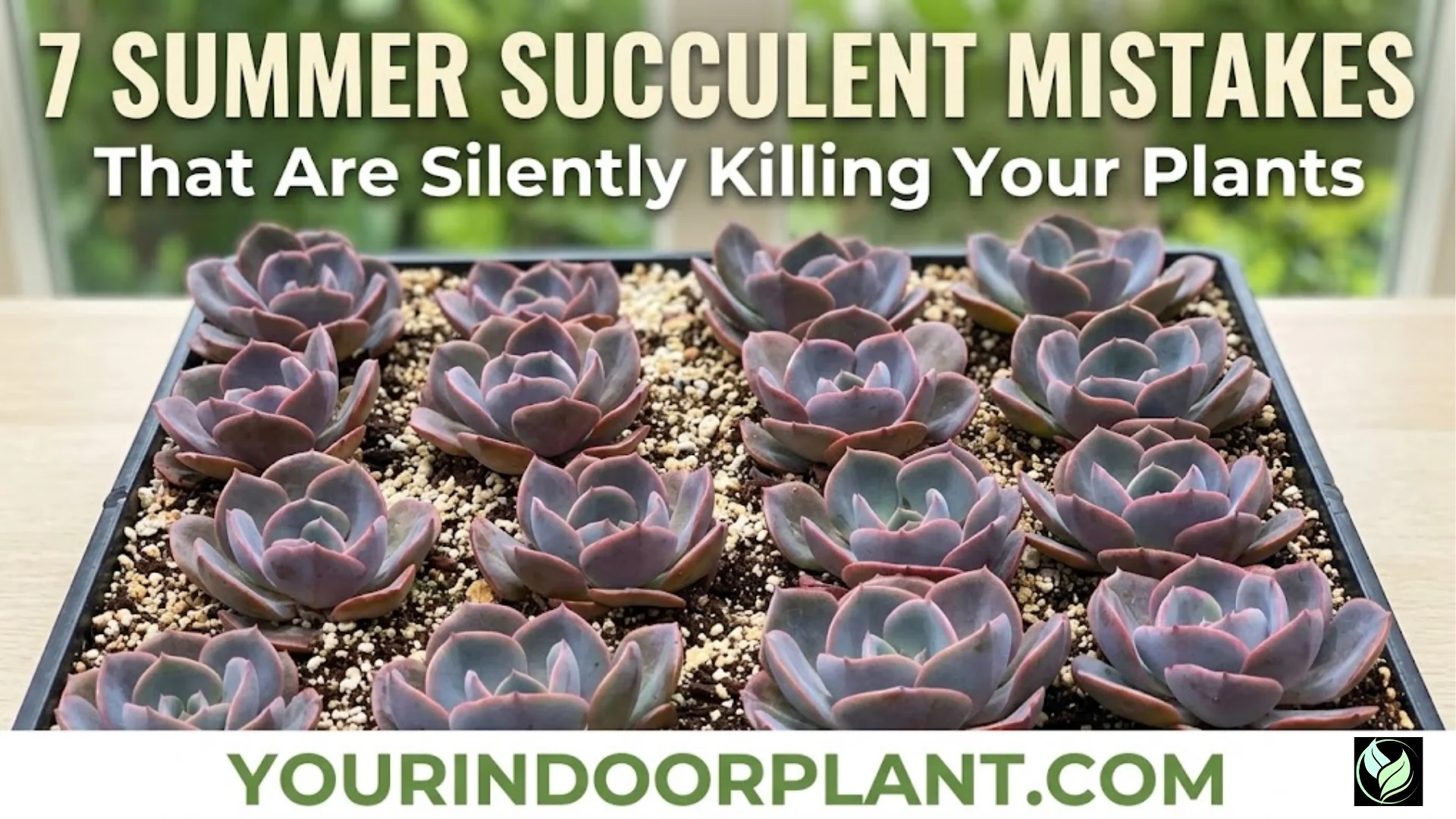
7 Things to Stop Doing to Your Succulents This Summer
🌵 Quick Answer: What Should You Stop Doing to Succulents in Summer?
Stop these 7 things immediately: watering on a fixed schedule instead of checking soil, keeping succulents indoors when they could go outside, blocking airflow around densely grouped plants, using the wrong pot material in high heat, fertilizing at full strength during peak summer temperatures, ignoring the difference between “heat stress” and “sun scorch,” and misting leaves in direct sunlight. Every one of these habits can kill a healthy succulent between June and August — and most people don’t realize the damage until it’s too late to reverse it.
Every summer, I lose at least one message a week from a reader saying the same thing:
“My succulents were perfect all winter. Now it’s summer and they’re dying. What happened?”
I know exactly what happened. Because I did every single one of these things myself in my first three summers of growing succulents in Portland.
Summer feels like it should be the easiest season for succulents. They’re desert plants. It’s hot. It’s bright. Surely they’re thriving?
Not always. And the reason surprises most people: summer is actually the season when the most common succulent care habits become the most damaging. The same routines that kept your plants stable through winter — the weekly watering, the shady windowsill, the cozy indoor spot — can actively harm them between June and August when temperatures climb, light intensity peaks, and the plant’s biology shifts into high gear.
I grow over 40 succulent varieties in my Portland home and garden. I’ve tracked their behavior across four full summer cycles. What follows are the seven mistakes I see most consistently — including three I made myself — with the exact fixes for each.
Why Summer Is Actually the Riskiest Season for Succulents
Before the list: a piece of context that changes everything.
Succulents store water in their leaves, stems, and roots. This storage system evolved for one specific purpose: surviving long dry periods between rain events in arid climates. The biology is built for drought followed by drainage — not for consistent moisture, and not for the kind of trapped heat that happens when a desert plant sits in a sealed indoor environment during a heatwave.
In their natural habitat — the Karoo desert of South Africa, the highlands of Mexico, the rocky cliffs of the Canary Islands — summer brings:
- Intense direct sun
- High daytime heat
- Cool nights (desert temperatures drop dramatically after sunset)
- Occasional heavy rain followed by fast drainage
- Constant airflow
In most of our homes, summer brings:
- Indirect light through glass
- Consistent warmth with no nighttime cooling
- Frequent light watering
- Stagnant air in closed rooms
- Humidity from cooking, showers, and AC units
The mismatch between what succulents evolved for and what we give them in summer is the root cause of almost every summer succulent death.
Understanding this makes every mistake on this list obvious in hindsight.
Mistake #1: Watering on a Schedule Instead of Reading the Plant
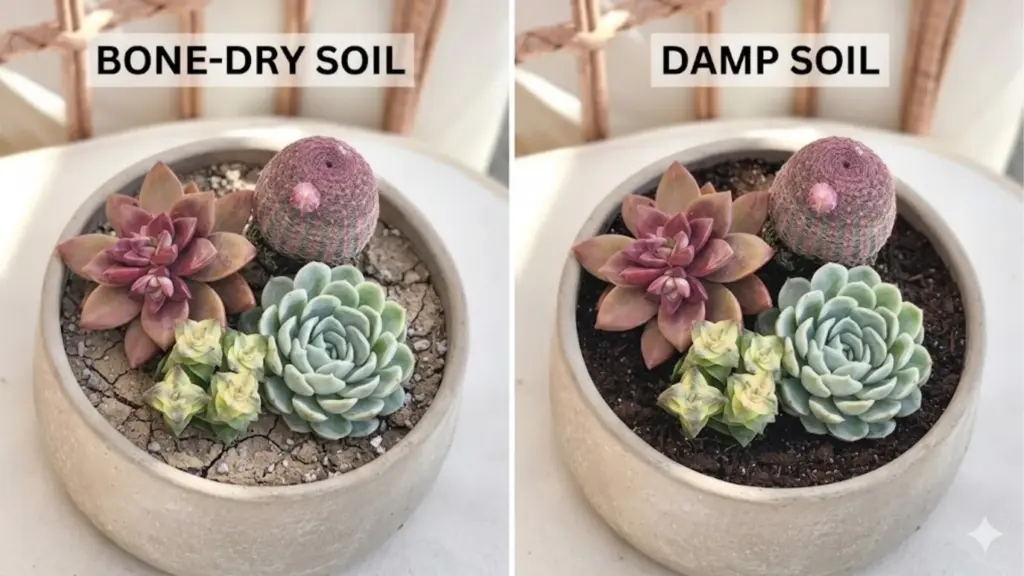
This is the mistake I made for my entire first summer of succulent growing. I watered every Sunday. Every plant, same day, same amount.
By August, two of my Echeverias had collapsed rosettes. One Haworthia had turned translucent and soft. I thought I was under-watering because it was hot.
I was overwatering. In the wrong conditions.
Here’s what nobody tells you about summer succulent watering:
The relationship between heat and watering is not linear. More heat does not automatically mean more water needed. What matters is whether the soil is dry — and that depends on:
- How much light the plant is getting (more light = faster evaporation)
- What type of pot it’s in (terracotta dries faster than plastic or ceramic)
- Whether it’s outdoors or indoors (outdoor airflow dries soil much faster)
- Whether it’s in active growth or heat dormancy (some succulents go dormant in extreme summer heat)
My watering test data (summer 2024, Portland):
I tracked four identical Echeveria ‘Lola’ plants under different summer conditions and measured days until soil reached complete dryness:
| Condition | Pot Type | Days Until Bone Dry |
|---|---|---|
| Outdoor, full morning sun | Terracotta | 3–4 days |
| Outdoor, partial shade | Terracotta | 5–7 days |
| Indoor, bright window | Terracotta | 7–10 days |
| Indoor, bright window | Plastic/ceramic | 12–16 days |
The same plant, the same season, the same watering amount — but the drying time varied by up to 4x depending on conditions.
A weekly watering schedule worked perfectly for the outdoor terracotta plant and killed the indoor ceramic one.
The fix — the “Bone Dry Test”:
Before every single watering, regardless of what day it is or how long it’s been:
- Push a bamboo chopstick or wooden skewer all the way to the bottom of the pot
- Pull it out slowly
- If it comes out with any soil clinging to it or feels even slightly cool → wait
- If it comes out completely clean, dry, and room temperature → water now
- When you water: water deeply and fully, until it flows from the drainage hole
- Empty the saucer immediately
The rule I follow without exception: If I’m not sure whether it’s dry enough, I wait two more days. With succulents, waiting is almost always the right choice. A succulent that’s slightly too dry recovers within hours of watering. A succulent that’s slightly too wet can develop root rot within days that’s irreversible.
Mistake #2: Keeping Outdoor-Ready Succulents Indoors All Summer
This one is about a missed opportunity as much as a mistake.
Most succulents — particularly the hardy rosette types like Echeveria, Sedum, Sempervivum, and Graptopetalum — genuinely thrive outdoors in summer. They produce their tightest, most compact rosettes. Their colors intensify. Their stems thicken. They grow at 2–3× the rate of the same plant kept indoors.
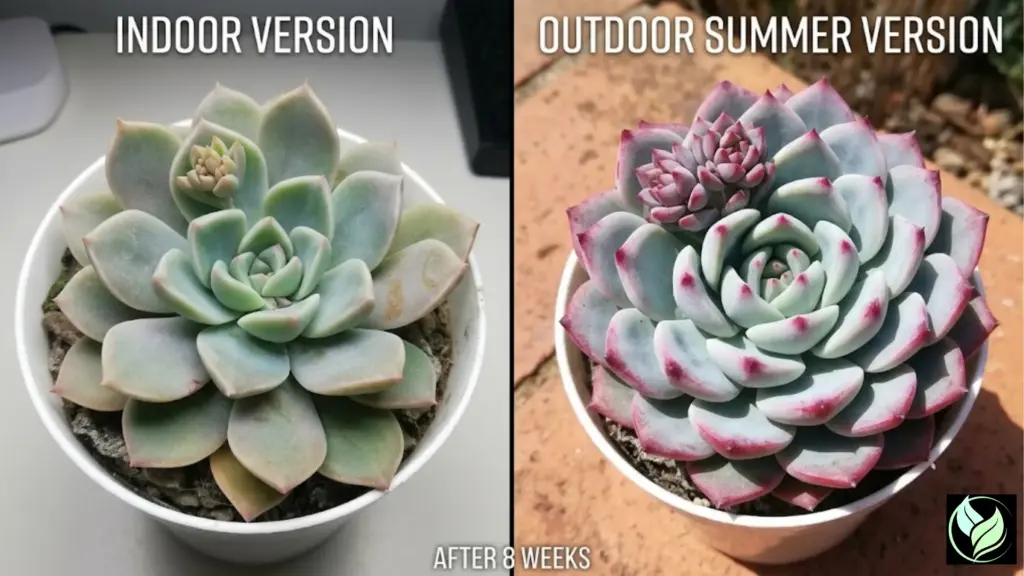
My comparison (summer 2023):
I took two identical Echeveria ‘Perle von Nürnberg’ plants from the same mother. One stayed on my east window indoors. One went outside on my south-facing Portland deck from late May through September.
| Metric | Indoor Plant | Outdoor Plant |
|---|---|---|
| Rosette diameter (start) | 3.2 inches | 3.2 inches |
| Rosette diameter (16 weeks) | 3.9 inches | 5.7 inches |
| Color | Muted purple-pink | Deep purple-pink with pink edges (stress coloration) |
| Offsets produced | 1 | 4 |
| Stem etiolation | Slight reaching toward window | None — compact |
| Overall condition | Good | Spectacular |
The outdoor plant grew 46% larger by diameter, produced 4× as many offsets, and developed dramatic stress coloration that the indoor plant never achieved.
Why stress coloration matters: The pink, red, orange, and purple tones that succulents develop outdoors are produced by pigments called anthocyanins — the plant’s sunscreen response to UV light and temperature fluctuation. These are the colors that make succulents visually stunning, and most succulents will never achieve them indoors where UV light is filtered by glass and temperatures remain stable.
How to safely move succulents outdoors:
The transition must be gradual. A succulent that’s been indoors all winter cannot go directly into full summer sun — the leaves will sunburn within days.
- Step 1 — Week 1: Place in full outdoor shade — under an overhang, porch, or beneath a shade cloth. No direct sun at all.
- Step 2 — Week 2: Move to a spot that gets 1–2 hours of direct morning sun (east-facing) with shade for the rest of the day.
- Step 3 — Week 3: Increase to 3–4 hours of direct morning sun.
- Step 4 — Week 4 onward: Most succulents can now handle full morning sun exposure. Avoid intense afternoon sun (west-facing) in climates above 95°F unless the plant is specifically heat-adapted.
Which succulents thrive outdoors in summer:
- ✅ Echeveria (all varieties)
- ✅ Sedum (most varieties)
- ✅ Sempervivum (extremely cold and heat hardy)
- ✅ Graptopetalum
- ✅ Graptoveria
- ✅ Aloe (established plants)
- ✅ Agave
- ⚠️ Haworthia (prefers bright shade outdoors — not full sun)
- ⚠️ Gasteria (same as Haworthia)
- ❌ Lithops (stay indoors — outdoor summer conditions are too variable)
When to bring them back inside: Before your first frost date. In Portland, I bring mine in by mid-October. In warmer climates, some can stay outdoors year-round.
Mistake #3: Blocking Airflow Around Tightly Grouped Succulents
Succulents look beautiful grouped together. I have arrangements on my deck with 8–12 plants packed tightly in shallow terracotta bowls.
But in summer, tight groupings without airflow create a microclimate that succulents genuinely hate: trapped humidity, elevated overnight temperatures, and stagnant air that prevents soil from drying properly between the rosettes.
What happens without airflow:
- The soil between tightly packed rosettes stays wet significantly longer
- The trapped humidity creates conditions for fungal issues — gray mold (Botrytis) is the most common summer problem in dense arrangements
- Rosette bases (where stem meets soil) stay damp, which is where most succulent rot begins
My observation: In the summer of 2022, I lost three Echeverias from the center of a tightly packed arrangement to what I initially thought was overwatering. The outer plants were fine. I hadn’t watered differently. The issue was airflow — the outer plants dried in 3–4 days after watering while the center plants were still damp at day 7.
The fixes:
| Situation | Fix |
|---|---|
| Tight indoor arrangement | Space plants at least 1–2 inches apart. Remove dead leaves from between rosettes weekly. |
| Dense outdoor arrangement | Position where it receives natural breeze. Avoid placing against walls or in enclosed corners. |
| Succulent bowl/dish garden | These arrangements need VERY fast-draining gritty mix and should dry out completely between waterings. |
| Shelves or racks | Leave space between pots. Avoid placing under shelves that block airflow from above. |
| After rain (outdoor) | Shake excess water from rosette centers — water sitting in the center of a rosette leads to crown rot |
My summer rule: I do a weekly pass through my succulent arrangements every Sunday morning. I remove any dead or dying leaves immediately — they trap moisture against the stem and become a fungal entry point. It takes 10 minutes and has prevented more summer rot than any other single practice.
Mistake #4: Using the Wrong Pot in Summer Heat
In winter, almost any pot works for succulents. The slow evaporation rate means even plastic pots dry out at an acceptable pace.
In summer, pot material becomes critical — particularly outdoors or in south-facing windows where temperatures can spike dramatically.
The problem with dark plastic pots in summer:
In direct summer sun, the soil inside a small dark plastic pot can reach temperatures of 120–140°F (49–60°C) on hot days. Root systems begin sustaining damage above approximately 95–100°F (35–38°C). The roots cook from the outside in while the plant above the soil looks completely fine — until it suddenly collapses.
My pot temperature experiment (July 2024, outdoor, Portland):
On a 92°F day, I measured internal soil temperature at 2-inch depth in three pot types after 4 hours of direct afternoon sun:
| Pot Type | Color | Internal Soil Temp at 2″ |
|---|---|---|
| Dark plastic | Black | 127°F (53°C) |
| White plastic | White | 104°F (40°C) |
| Terracotta | Natural orange | 91°F (33°C) |
| Glazed ceramic | White | 98°F (37°C) |
The dark plastic pot reached temperatures nearly 40°F hotter than the terracotta pot in identical conditions.
The fix:
- Outdoors in summer: Use terracotta pots only. The porous walls allow evaporative cooling and keep root zone temperatures significantly lower.
- Indoors near south/west windows: Terracotta or light-colored ceramic. Avoid dark plastic in high-sun positions.
- If you can’t change the pot: Wrap dark plastic pots in jute, burlap, or place inside a light-colored outer pot to reduce direct sun on the pot walls.
- For outdoor arrangements: Avoid dark shallow dishes in full afternoon sun — the thin walls provide zero insulation.
Mistake #5: Fertilizing at Full Strength During Peak Summer Heat
Summer is growing season for most succulents, so fertilizing makes sense — right?
Partially. The timing and strength matter enormously, and this is where I see a lot of well-intentioned plant parents damage their plants.
The problem with full-strength summer fertilizing:
When soil temperatures are high and the plant is under heat stress, the roots are less efficient at processing nutrients. Excess fertilizer salts accumulate in the root zone. This creates a condition called fertilizer burn — the high concentration of salts draws water out of root cells through osmosis, causing the same symptoms as underwatering even when soil moisture is adequate.
Additionally, high nitrogen fertilizers stimulate rapid soft growth. In the heat of summer, this new growth is often pale, stretched, and weak — the plant is growing faster than it can produce the compact, thick-walled cells that make succulents drought-resistant.
My fertilizing approach for summer:
| Month | Fertilizer | Strength | Notes |
|---|---|---|---|
| March–April | Balanced liquid (balanced N-P-K) | Half-strength | Growth resuming — start gently |
| May | Low-nitrogen liquid (5-10-10 or similar) | Half-strength | Shift to lower nitrogen before summer |
| June | Low-nitrogen liquid | Quarter-strength | Peak heat approaching |
| July | Low-nitrogen liquid | Quarter-strength ONLY if below 90°F | Skip on extreme heat days |
| August | Skip entirely if above 95°F consistently | — | Heat dormancy period |
| September | Resume half-strength low nitrogen | Half-strength | Temperatures dropping |
| October–February | Nothing | — | Dormancy |
Why low nitrogen in summer? High nitrogen (the first number in NPK ratios) drives leafy, soft growth. For succulents in summer heat, you want the plant to be compact and stress-tolerant. Lower nitrogen with higher phosphorus and potassium supports root development and cell-wall strength — exactly what heat-stressed succulents need.
Signs of fertilizer burn in summer:
- Brown, crispy leaf tips despite adequate watering
- Leaves that look dehydrated even when soil is moist
- White crusty residue on soil surface
- Wilting despite correct watering
Fix: Flush soil thoroughly with clean water 4–5 times consecutively, skip all fertilizing for 6–8 weeks, resume at quarter-strength.
Mistake #6: Confusing Sun Scorch With Heat Stress (They Need Different Fixes)
This is the most important distinction on this list — and almost no beginner article covers it clearly.
Sun scorch and heat stress look similar on a succulent. Both produce damaged leaves. Both appear in summer. But they have completely different causes and completely different fixes.
Getting this wrong means applying the wrong solution and potentially making the damage worse.
A) Sun Scorch:
| Feature | Description |
|---|---|
| Cause | Too much direct UV radiation — too fast a transition from indoor to outdoor sun |
| Appearance | White, tan, or brown patches on the upper surfaces of leaves — specifically the side facing the sun |
| Pattern | Localized — only on the sun-facing side of the plant |
| Texture | Dry, papery, sometimes crispy |
| Affected leaves | The outermost, most exposed leaves first |
| Reversible? | No — scarred tissue doesn’t heal. But new growth will be undamaged. |
B) Heat Stress:
| Feature | Description |
|---|---|
| Cause | Excessive ambient temperature, often combined with poor airflow and high soil temperature |
| Appearance | Entire leaves become pale, translucent, soft, or mushy — especially at the base |
| Pattern | Affects the whole plant or inner leaves first (where airflow is worst) |
| Texture | Often soft and mushy rather than crispy |
| Affected leaves | Can affect any part of the plant — not necessarily sun-facing |
| Reversible? | Partially — remove damaged leaves, improve conditions, plant may recover |
The critical difference:
- Sun scorch = the plant received too much UV radiation too suddenly. The fix is shade and gradual reintroduction to sun.
- Heat stress = the plant is too hot overall. The fix is increased airflow, cooler placement, potentially switching to terracotta, and adjusting watering.
If you apply the sun scorch fix (more shade) to a heat-stressed plant: The plant stays in a warm, stagnant, low-airflow environment while you reduce the only factor (sun) that was helping evaporate moisture from the soil. The heat stress continues or worsens.
If you apply the heat stress fix (more airflow, change position) to a sun-scorched plant: You may move it into a different high-sun position without gradual transition and add new sun scorch on top of the existing damage.
My diagnosis checklist:
Is the damage dry and papery?
  └── Yes → Look at which side: only the sun-facing side?
        └── Yes → Sun scorch → provide shade, slow reintroduction
        └── No, all sides → Heat stress component present too

Is the damage soft, mushy, or translucent?
  └── Yes → Heat stress → check soil temp, airflow, pot type
        └── Also check for root rot if base is soft
Mistake #7: Misting Leaves in Summer Sunlight
This one is quick and important.
Misting succulents is generally unnecessary — they get all the moisture they need through the soil. But in summer, misting becomes actively harmful if you do it at the wrong time.
Why misting + summer sun = leaf damage:
Water droplets sitting on succulent leaves in direct or intense indirect sunlight act as tiny magnifying lenses. They concentrate the light onto a single point on the leaf surface, heating that point to temperatures that can burn the leaf cells. The result: small, round, bleached burn marks scattered across the leaf surface — different from the larger patches of sun scorch, but equally irreversible.
I made this mistake with a Graptoveria ‘Opalina’ in July 2021. I misted it on a warm afternoon to “cool it down” and came back the next morning to find dozens of small white circular burn marks across every exposed leaf. The marks never faded. Every new leaf that grew in was unmarked — but the damaged leaves looked burned for the remaining two years I grew the plant.
The rules:
- Don’t mist succulents during daylight hours in summer — ever
- If you mist at all (for propagation purposes or pest treatment), do it at dusk or in the evening when direct sun has passed
- Don’t mist outdoor succulents before expected rain — the rain will wet them anyway, and pre-misting adds no benefit while adding morning moisture that sits in the heat of the day
- For pest treatment (neem oil, insecticidal soap): Apply in the morning before temperatures peak or in the evening after sun intensity drops
The honest truth: Most succulents never need to be misted. The practice carries more risk than benefit for established plants. The one exception is propagation — freshly laid leaf cuttings benefit from light misting to prevent desiccation before they root. But even then, I do this in the early evening only.
The Summer Succulent Survival Checklist
Use this every week between June and September:
Every week:
□ Bone Dry Test before any watering — no exceptions
□ Remove dead or dying leaves from rosette bases
□ Check for pests (mealybugs love warm weather)
□ Check soil between tightly grouped plants —
  is the center still damp?
□ Inspect for early signs of rot at stem bases

Every month:
□ Fertilize at quarter-strength
  (skip if temperatures above 95°F)
□ Check pot temperatures — are any getting
  dangerously hot in afternoon sun?
□ Assess growth — etiolation (stretching) means
  more light is needed

At the start of summer:
□ Begin gradual outdoor transition if moving plants out
□ Switch dark plastic pots to terracotta for
  outdoor plants
□ Space any dense arrangements to improve airflow
□ Check drainage holes — any blocked by roots?
What Summer Succulents Actually Need
Now that we’ve covered what to stop doing, here’s the positive picture:
| Factor | Summer Requirement | My Setup |
|---|---|---|
| Light | 4–6 hours direct sun (outdoors) or bright indirect indoors | South-facing deck with morning sun, shade cloth for afternoon |
| Water | Deeply but infrequently — only when soil is bone dry | Every 3–4 days outdoor terracotta, every 10–14 days indoor plastic |
| Soil | Extremely well-draining gritty mix | 50% coarse grit/perlite + 50% potting mix for outdoor plants |
| Pot | Terracotta outdoors, any type with drainage indoors | All outdoor plants in terracotta by June |
| Airflow | Constant — essential outdoors, important indoors | Outdoor deck with consistent breeze |
| Fertilizer | Low-nitrogen at quarter-strength, skip above 95°F | Stops completely in August |
| Temperature | 70–95°F ideal — above 100°F, provide afternoon shade | Shade cloth on Portland’s hottest days (rare but happens) |
Common Summer Succulent Problems: Rapid Diagnosis
| What You See | Time of Year | Most Likely Cause | Urgent? |
|---|---|---|---|
| White/tan patches on sun-facing leaves | After outdoor move | Sun scorch | Low — move to shade, new growth fine |
| Entire plant pale and soft | Peak summer | Heat stress | Medium — improve airflow + terracotta |
| Brown crispy tips throughout | Summer | Fertilizer burn or underwatering | Medium — check soil, flush if crusty |
| Mushy, soft base | Any | Root rot | 🔴 Urgent — unpot immediately |
| Small round white dots on leaves | After misting | Misting burn | Low — avoid daytime misting |
| Stretching, long gaps between leaves | Summer indoors | Insufficient light | Low — more sun needed |
| Shriveled, wrinkled leaves | Peak summer heat | Underwatering or heat dormancy | Medium — check soil, water if dry |
| White cottony spots in leaf axils | Summer | Mealybugs | Medium — treat with rubbing alcohol |
| Gray fuzzy mold on stems | Dense arrangement | Botrytis (gray mold) | High — improve airflow, remove affected |
My Summer Succulent Setup (What Actually Works)
For transparency — here’s exactly how I manage my 40+ succulents during Portland summers:
Outdoor plants (approximately 25 plants):
- All in terracotta pots or unglazed ceramic
- South-facing deck with natural morning sun
- 30% shade cloth installed over the sunniest section for days above 90°F
- Watered when soil is bone dry — averages every 3–5 days in June/July
- No fertilizer after mid-August
- Checked weekly for rot, pests, and airflow issues
Indoor plants (approximately 15 plants):
- East and south-facing windowsills
- Mix of terracotta and ceramic
- Watered every 10–14 days in summer (finger test every time)
- Monthly quarter-strength low-nitrogen fertilizer through September
- No misting at any time
The single most impactful thing I’ve done for summer success: Switching all outdoor plants to terracotta three years ago. Before that switch, I lost an average of 4–5 plants per summer to root rot in dark plastic pots. Since the switch: zero summer root rot losses.
Frequently Asked Questions
-
Should I water succulents more in summer because it’s hot?
Not automatically. Water frequency should be determined entirely by whether the soil is bone dry — not by the temperature outside. Outdoor succulents in terracotta pots may need water every 3–5 days because the pot dries quickly. Indoor succulents in plastic pots may still need 10–14 days even in summer. Always use the bone dry test before watering, every single time.
-
Why are my succulents turning mushy in summer?
Mushy succulents in summer are almost always caused by one of three things: overwatering (soil staying wet too long between waterings), root rot from previously overwatered roots that are now failing, or heat stress causing cell wall breakdown in extreme temperatures. Check the base of the plant first — if it’s soft and mushy at soil level, you have root rot. Unpot immediately, trim rotten roots, let air-dry 24 hours, repot in dry gritty mix.
-
Can I put succulents in full summer sun?
Yes — but only after a gradual transition. Move them to deeper shade outdoors first for 1–2 weeks, then increase direct sun exposure slowly over 3–4 weeks. Succulents that have been indoors all winter are not adapted to full summer UV intensity and will sunburn within days if moved directly into full sun. Once acclimated, most succulents love 4–6 hours of direct morning sun.
-
My succulent leaves are turning red/purple in summer — is this bad?
No — this is stress coloration and it’s completely normal and desirable. The red, purple, orange, and pink tones are produced by anthocyanin pigments triggered by UV light exposure, temperature fluctuation, and mild drought stress. This is the same mechanism that produces fall leaf colors in trees. It doesn’t hurt the plant at all and makes succulents significantly more beautiful. Enjoy it.
-
How do I know if my succulent is sun-scorched or just stressed?
Sun scorch produces dry, papery, white or tan patches specifically on the side of the plant facing the light source — localized damage on sun-exposed surfaces only. Heat stress produces softer, more widespread changes — pale coloration, translucency, or softness throughout the plant not limited to one side. Sun scorch fix: shade and gradual reintroduction. Heat stress fix: better airflow, cooler position, terracotta pot.
-
Do succulents go dormant in summer?
Some do — particularly certain Echeveria, Aeonium, and Crassula species from winter-rainfall climates. These plants evolved to survive dry hot summers by going semi-dormant: they slow or stop growing, may drop lower leaves, and need significantly less water. Aeoniums in particular look almost dead in summer — their rosettes close up and the plant looks stressed even when it isn’t. This is normal. Reduce watering dramatically and don’t fertilize these plants in summer.
-
What’s the best soil mix for succulents in summer?
For outdoor summer plants, I use a 50/50 mix of coarse perlite or grit and standard potting mix. The higher grit ratio improves drainage and prevents the waterlogging that’s more dangerous in summer heat. For indoor plants, my standard 80/20 potting mix to perlite ratio works well year-round. Never use pure potting mix alone for succulents in summer — it holds too much moisture.
-
How do I treat mealybugs on succulents in summer?
Mealybugs are the most common summer succulent pest — warm temperatures accelerate their life cycle. Treatment: dip a cotton swab in 70% isopropyl rubbing alcohol and touch each visible mealybug directly. The alcohol kills them on contact. Repeat every 5–7 days for 4 weeks to catch newly hatched eggs. For severe infestations, spray the entire plant with a diluted neem oil solution in the early morning or evening — never in direct sun. Isolate affected plants immediately to prevent spread.
Your Complete Succulent Care Resource
| I Need Help With | Go To |
|---|---|
| General succulent care year-round | How to Fix Leggy Succulents |
| Increasing humidity around plants | How to Increase Humidity for Houseplants |
| Best fertilizers | Best Fertilizers for Indoor Plants |
| Snake plant summer care | Snake Plant Care Guide |
| Other easy summer plants | Best Indoor Plants for Beginners |
Updated May 2026 — based on 4 full summer cycles managing 40+ succulent varieties in Portland, OR, including controlled experiments on pot temperature, light exposure, and soil mix performance