
Snake Plant Care Made Simple — What Actually Works (From 10 Years of Growing)

The first snake plant I ever owned died within three months. I watered it every week, gave it a prime sunny spot, and repotted it into rich, dark potting soil the day I brought it home. I thought I was being a good plant parent.
The roots turned to mush. The leaves collapsed from the base. I pulled it out of the pot and the smell was unforgettable.
That was ten years ago. Today, I have twelve snake plants in my home — from towering Laurentii to compact Bird’s Nest varieties. One of them has bloomed twice. I’ve propagated enough pups to give them as gifts to everyone I know.
Here’s the thing about snake plants: they don’t need you. They need you to leave them alone. Every problem I’ve ever had with a snake plant came from doing too much, not too little.
This guide is everything I learned the hard way — so you don’t have to.
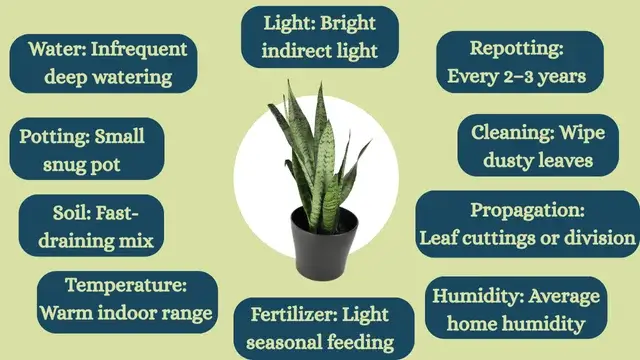
🌿 SNAKE PLANT CARE AT A GLANCE
Quick Answer: Snake plants need bright indirect light, watering only when the soil is completely bone-dry (every 2–6 weeks), fast-draining soil (2 parts cactus mix + 1 part perlite), and a terracotta pot with a drainage hole. The single most common mistake — and the #1 killer — is overwatering. When in doubt, always wait.
| 💧 Water | Every 2–6 weeks — only when soil is bone-dry. Use the chopstick test: clean & dry = water now |
| ☀️ Light | Bright indirect light is ideal. Tolerates low light, but growth slows significantly |
| 🪨 Soil | 2 parts cactus mix + 1 part perlite. Never use regular potting soil alone |
| 🪴 Pot | Terracotta with drainage hole — always |
| 🌡️ Temperature | 65–80°F (18–27°C) — keep away from cold drafts and heating vents |
| 💪 Fertilizer | Half-strength balanced feed, once monthly in spring/summer. Nothing in fall/winter |
| ⚠️ #1 Mistake | Overwatering — when in doubt, wait |
Full Care Specs (My Personal Setup)
| Care Factor | Requirement | My Personal Setup |
|---|---|---|
| Light | Bright indirect (ideal) / Low light (tolerated) | East-facing window, Portland home |
| Water — Spring/Summer | Every 2–4 weeks when top 2–3″ is dry | Chopstick test — bone dry before watering |
| Water — Fall/Winter | Every 4–8 weeks — soil must be fully dry | Sometimes goes 6 weeks between waterings |
| Soil | Fast-draining cactus/succulent mix | 2 parts cactus mix + 1 part perlite |
| Pot | Terracotta with drainage hole | Never plastic — holds too much moisture |
| Temperature | 65–85°F / 18–29°C | Away from cold drafts & AC vents |
| Humidity | Low (30–50%) — no misting needed | No special humidity setup required |
| Fertilizer | Half-strength balanced, monthly | Spring & summer only — nothing in winter |
| Repotting | Every 2–4 years or when root-bound | Only go 1–2″ wider each time |
| Toxicity | Toxic to cats & dogs (saponins) | Keep completely out of reach of pets |
My Snake Plant Journey (Or: How I Learned to Stop Killing Them)
When I started, I treated my snake plant like my other tropicals. More water, more light, more attention. Wrong. Completely wrong.
Snake plants are succulents. They store water in their thick, upright leaves. They come from West Africa, where they survive drought by doing absolutely nothing until the rains return. They are built for neglect.
Once I understood this, everything changed. I stopped fussing. I started ignoring. And my plants thrived like never before.
The 5 Rules I Follow (And Never Break)
After a decade of growing all [16 snake plant varieties](link to /snake-plant-varieties/) I keep in my home, here’s my personal system. It’s simple. It’s repeatable. It works.
Rule 1: Light — Bright Indirect, But Honestly, Whatever
Snake plants are famously low-light tolerant. I have one in a hallway with zero natural light, and it’s still alive after four years.
But alive is not thriving.
Here’s what I noticed: the snake plant in my bright living room, near an east-facing window, grows three times faster than the one in my hallway. Its leaves are thicker, the variegation is sharper, and it produces pups regularly.
My rule: I keep my favourite snake plants in bright, indirect light. The ones in low-light spots? They’re fine. They’re just not growing much. If you want growth and eventual flowers, give them light.
| Light Level | What to Expect | Best Varieties for This Level |
|---|---|---|
| Bright indirect (east/west window) | Fast growth, vivid colour, regular pups | All varieties — where they truly thrive |
| Medium indirect (a few feet from window) | Steady growth, healthy leaves | Laurentii, Trifasciata, Cylindrica |
| Low light (dim rooms, north window) | Very slow growth, survives but won’t flourish | Trifasciata, Zeylanica |
| Direct sun (south window, full blast) | Leaf scorch, bleaching, brown tips | None — avoid this entirely |
Rule 2: Water — The Chopstick Test That Saved Everything
I take a plain bamboo chopstick — the kind that comes with takeout — and push it all the way to the bottom of the pot.
Pull it out slowly. Here’s exactly what you’re looking for:
✅ WATER NOW: Chopstick comes out completely clean and dry. No soil clinging anywhere. No moisture smell. No cool sensation. Bone dry throughout.
⏳ WAIT: Any soil clings to the chopstick — even a little. OR you can smell any dampness at all. OR the stick feels even slightly cool to the touch. Wait 3–5 more days and test again.
❌ NEVER: Water on a fixed schedule (weekly, biweekly, monthly). Your home’s humidity, season, and light level change everything. The chopstick doesn’t lie. A calendar does.
I’ve used this method for 10 years across all 12 of my snake plants. It has never failed me once.
💡 Pro tip: The pot’s weight tells you almost as much as the chopstick. A dry snake plant pot feels noticeably lighter than a freshly watered one. After a few weeks, you’ll feel the difference without even using the chopstick.
Rule 3: Soil — Skip the Regular Potting Mix
That rich, moisture-retaining potting mix I used on my first snake plant? That’s what killed it.
Snake plants need drainage above all else. I mix my own: 2 parts cactus/succulent mix, 1 part perlite or coarse sand. This creates air pockets and lets water flow straight through. The roots stay dry, which is exactly how they like it.
I also only use terracotta pots for my snake plants. Plastic holds moisture. Terracotta breathes. My terracotta pots have saved more snake plants than I can count.
If you’re not sure which mix to buy, see my guide to the best soil for snake plants— I tested five different brands side by side.
Rule 4: Fertilizer — Barely Any
I fertilize my snake plants once a month during spring and summer with a balanced houseplant fertilizer, diluted to half strength. In fall and winter, nothing.
They’re slow growers. They don’t need much. Over-fertilizing causes brown leaf tips — which I learned the hard way after getting too enthusiastic one spring.
Signs you’ve over-fertilized:
- Brown, crispy leaf tips (most common)
- White crusty residue on soil surface (salt buildup)
- Leaves losing their colour or turning pale
If this happens, flush the soil with plenty of plain water to dilute the salt buildup, and skip feeding for 2–3 months.
Rule 5: Temperature — Comfortable Room Temperature, No Extremes
My home stays between 65–80°F year-round, and my snake plants are happy. I once left one too close to a drafty window in winter, and the leaves developed brown, water-soaked patches within days. Cold damage is quick and irreversible.
Keep snake plants away from:
- Cold drafts (windows in winter, exterior doors)
- Air conditioning vents (cold + dry = double stress)
- Heating vents (hot + dry = dehydration + brown tips)
- Temperatures below 50°F / 10°C — growth stops and damage begins
See my full snake plant winter care guide for exactly how I manage my 12 plants through Portland winters.
Monthly Care Schedule
Based on 10 years of growing snake plants in Portland, OR. Adjust timing based on your home’s humidity and light levels.
| Month | Watering | Fertilizer | Light Adjustment | Notes |
|---|---|---|---|---|
| January | Every 5–6 weeks | None | Move closer to window | Minimal growth mode |
| February | Every 4–6 weeks | None | Keep near window | Days getting longer |
| March | Every 3–4 weeks | Start half-strength | Normal position | Growth resumes |
| April | Every 2–3 weeks | Monthly | Normal position | Active growing season |
| May | Every 2–3 weeks | Monthly | Normal or filtered | Watch for strong sun |
| June | Every 2–3 weeks | Monthly | Filtered light | Peak growing season |
| July | Every 2–4 weeks | Monthly | Filtered light | Heat can dry soil faster |
| August | Every 2–4 weeks | Monthly | Filtered light | Same as July |
| September | Every 3–4 weeks | Last feed of the year | Normal | Begin slowing down |
| October | Every 4–5 weeks | None | Move closer to window | Days shortening |
| November | Every 4–6 weeks | None | Brightest spot available | Pre-dormancy |
| December | Every 5–8 weeks | None | Brightest spot available | Dormancy — leave it alone |

Propagation: What Actually Works (And What Doesn’t)
I’ve propagated snake plants every way possible. Here’s what I actually use now — and what I’ve abandoned:
- Division is my go-to. When a plant outgrows its pot, I pull the whole thing out, find a healthy clump with its own roots and rhizome, and separate it with a clean, sharp knife. Then I pot it in its own terracotta pot with my succulent mix. This gives me an instant new plant — and if the parent was variegated (like Laurentii), the baby keeps the same coloring. Division is the only propagation method that preserves variegation.
- Water propagation is fun but slow. I take a healthy leaf, cut it at the soil line, let it callus for 2–3 days, then place the bottom inch in water. Roots appear in 4–8 weeks. The catch: if you propagate a variegated snake plant this way, the new leaves will revert to solid green. No gold edges. No stripes. Just plain green. Division is the only way around this.
- Soil propagation requires patience. Same start as water propagation, but plant the calloused cutting directly into dry soil. Water sparingly. Roots form slowly, and you won’t know if it’s working for weeks. But it saves the transplanting step later.
| Method | Time to Root | Preserves Variegation? | Difficulty | Best For |
|---|---|---|---|---|
| Division | Immediate | ✅ Yes | Easy | Mature plants with pups |
| Water propagation | 4–8 weeks | ❌ No | Easy | Any solid-green variety |
| Soil propagation | 6–10 weeks | ❌ No | Medium | When you want to skip transplanting |
For full step-by-step photos and instructions, see my complete snake plant propagation methods guide.
Common Problems I’ve Faced (And Exactly How I Fixed Them)
For a deeper diagnosis, see my complete guide to [common snake plant problems](link to /snake-plant-problems/) — but here’s my personal troubleshooting table:
| Symptom | My Experience | Root Cause | Solution |
|---|---|---|---|
| Yellow, mushy leaves | I overwatered. Roots were rotting. | Root rot from excess moisture | Unpot, trim rotten roots, let dry 24 hrs, repot in fresh dry mix |
| Brown, crispy leaf tips | Underwatering OR low humidity OR over-fertilizing | Dry conditions or salt buildup | Deep water thoroughly, check moisture before next watering |
| Drooping, leaning leaves | Not enough light, or root rot starting | Structural weakness or root damage | Move to brighter spot, check roots immediately |
| No new growth for months | Winter dormancy or too-dark location | Natural seasonal slowdown | Wait for spring, or move to brighter light — don’t fertilize to “wake it up” |
| White cottony spots | Mealybugs. I had them once in year three. | Pest infestation | Dab each spot with rubbing alcohol on a cotton swab. Repeat weekly for 4 weeks |
| Wrinkled, shrivelled leaves | Extended underwatering | Severe dehydration | Deep water, let drain fully, check weekly |
| Brown water-soaked patches | I left one near a cold drafty window | Cold damage | Remove damaged leaves, move to warmer spot — damage is irreversible |
If your snake plant is drooping, I also wrote a dedicated guide on why snake plants droop and how to revive them.
My Seasonal Snake Plant Routine

🌱 Spring & Summer (Active Season)
- Water every 2–3 weeks (always use the chopstick test first)
- Fertilize monthly at half-strength
- Propagate now if needed — warm weather means faster rooting
- Move outdoors to a shaded spot if desired (bring back inside before temperatures drop below 50°F / 10°C)
- Check for pests during active growth — catch them early
🍂 Fall & Winter (Rest Season)
- Reduce watering to once a month or less
- Stop fertilizing completely — no exceptions
- Keep away from cold drafts and cold windows
- Expect little to no visible growth — this is completely normal
- Resist the urge to water more “because the leaves look sad” — they’re just resting
For my complete cold-weather system, read the full snake plant winter care guide.
Are Snake Plants Safe for Pets?
No — and this is important.
I don’t have cats myself, but all snake plant varieties are toxic to cats and dogs. They contain saponins, naturally occurring chemical compounds that cause nausea, vomiting, and diarrhea if any part of the plant is ingested.
If you have a curious pet that chews leaves, keep your snake plant completely out of reach — or choose a pet-safe alternative like spider plants or Boston ferns.
I wrote a detailed, vet-referenced guide on this: Are Snake Plants Toxic to Cats? Expert Safety Guide Every Owner Needs.
10 Benefits of Growing Snake Plants (Beyond Looking Good)
Snake plants don’t just survive in your home — they contribute to it. See the full breakdown in my dedicated post: What Does a Snake Plant Do for Your House? 10 Amazing Benefits.
My Final Take
The snake plant earned its widespread Plant of the Year recognition for a reason. It’s beautiful, it’s nearly indestructible, and it asks for almost nothing. I’ve killed far more plants than I’d like to admit — but once I learned to step back and let my snake plants do their thing, they rewarded me with years of steady, quiet growth.
If you take one thing from this guide, let it be this:
When in doubt, don’t water.
What’s your experience with snake plants? Drop a comment — I read them all. And if you found this helpful, check my complete guide to snake plant problems solved from 10 years of growing.
Snake Plant Watering Calculator
FAQs
How often should I water a snake plant?
Water your snake plant every 2–6 weeks depending on the season. In spring and summer, check every 2–3 weeks. In fall and winter, check every 4–6 weeks. Always use the chopstick test — push a chopstick to the bottom of the pot and only water when it comes out completely clean and dry. Never water on a fixed schedule.
Can snake plants survive in low light?
Yes, snake plants tolerate low light better than almost any other houseplant — but tolerating low light is not the same as thriving in it. In very low light, growth slows dramatically and leaves may lose colour vibrancy. For best results, place them near an east or west-facing window with bright indirect light.
Why are my snake plant leaves turning yellow?
Yellow leaves on a snake plant almost always signal overwatering. The roots are sitting in too much moisture, cutting off oxygen and inviting rot. Check the soil immediately — if it feels damp or the pot feels heavy, stop watering and let the soil dry out completely. If the base of the plant feels soft or mushy, check the roots for rot.
What is the best soil mix for snake plants?
The best soil for snake plants is 2 parts cactus/succulent mix combined with 1 part perlite. This creates the fast drainage snake plant roots require. Never use standard potting soil alone — it retains too much moisture and is the second most common cause of snake plant death after overwatering.
Do snake plants need fertilizer?
Snake plants need very little fertilizer. Feed with a balanced houseplant fertilizer diluted to half-strength, once a month during spring and summer only. Stop completely in fall and winter when the plant enters dormancy. Over-fertilizing causes brown leaf tips and salt buildup in the soil.
How big do snake plants get indoors?
Size depends on the variety. Standard Sansevieria Laurentii reaches 2–4 feet indoors. Taller varieties can exceed 4 feet. Compact varieties like Bird’s Nest stay under 12 inches. Growth is slow — expect 2–4 new leaves per growing season under good conditions. See all [16 snake plant varieties](link to /snake-plant-varieties/) and their typical sizes.
Are snake plants safe for cats and dogs?
No. All snake plant varieties are toxic to cats and dogs. They contain saponins, which cause vomiting, nausea, and diarrhea if any part of the plant is ingested. Keep snake plants out of reach of all pets. If your animal eats any part of the plant, contact your vet or the ASPCA Animal Poison Control Center immediately at 888-426-4435.
Can I put my snake plant outside in summer?
Yes, but transition it gradually. Start in deep outdoor shade for 1–2 weeks before moving to bright indirect outdoor light. Never place an indoor snake plant directly into full outdoor sun — the leaves will bleach and burn within days. Bring it back indoors before temperatures drop below 50°F (10°C).