
Monstera Leaves Turning Brown: Causes and How to Fix Them

Monstera leaves turning brown can have several causes, and the location and texture of the brown area often tell you more than the color itself. Crispy brown tips usually point toward moisture or salt issues, while soft, dark spots deserve a closer look at the soil and roots. Direct sun, dry indoor conditions, pests, and recent changes can also damage the leaves.
Quick answer: Monstera leaves most often turn brown because of inconsistent watering, dry conditions, excessive direct sunlight, salt buildup, or root stress. Before changing your plant’s care routine, look at where the browning starts, whether the tissue is dry or soft, and how moist the soil is.
Quick Diagnosis Table
| What You See | Most Likely Cause | What to Check First |
|---|---|---|
| Brown, crispy tips or edges | Dry soil, inconsistent watering, or dry air | Soil moisture |
| Brown tips + white crust on soil | Salt buildup | Fertilizer and water history |
| Brown, papery patches on sun-facing leaves | Too much direct sun | Light exposure |
| Soft, dark-brown or black spots | Root or water stress | Soil, drainage, and roots |
| New leaf turns brown before unfurling | Root or environmental stress | Roots and recent changes |
| White or cream variegated sections turn brown | Stress to low-chlorophyll tissue | Light and watering |
| Brown leaves after repotting | Root disturbance or environmental stress | Recent changes |
| Brown + yellow leaves | Watering, root, or light problem | Soil and roots |
| Brown leaves + webbing or stippling | Pests | Leaf undersides |
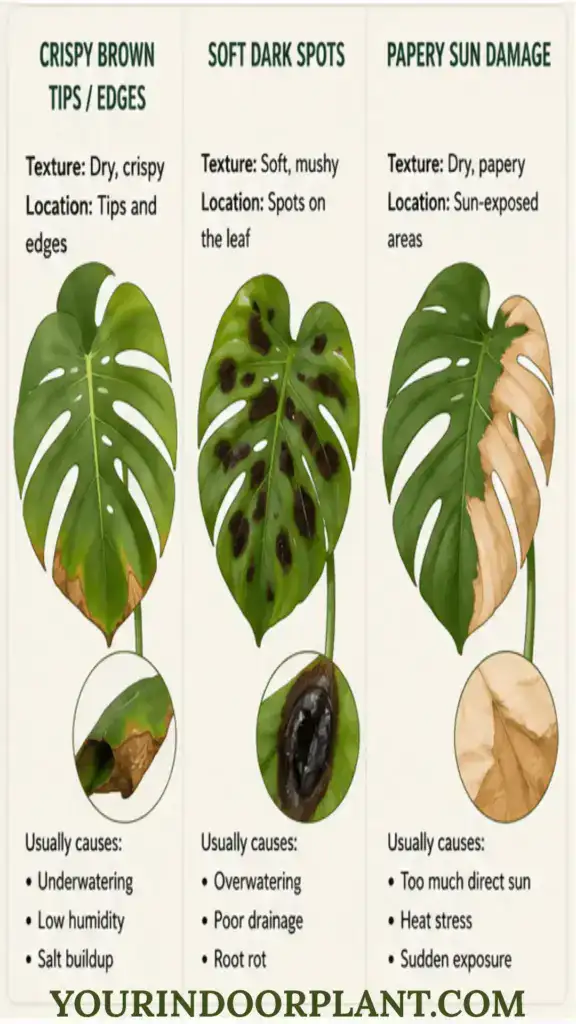
1. Brown, Crispy Tips and Edges
Brown, crispy Monstera tips usually mean the plant has experienced a moisture-related or environmental problem, so check the soil before assuming humidity is the cause.
When the tips or edges turn brown, dry, and crunchy, the affected tissue has usually lost moisture. This can happen when the root zone becomes too dry, watering is inconsistent, the indoor air is very dry, or salts have accumulated in the soil.
The Missouri Botanical Garden also notes that brown tips on indoor plants can be associated with low humidity, excessive fertilizer or soluble salts, poor water quality, overwatering, underwatering, and direct sunlight.
One problem I see with indoor plants is not necessarily watering too infrequently, but watering too lightly. If only a small amount of water is added each time, parts of the root ball can remain dry even though the surface appears damp.
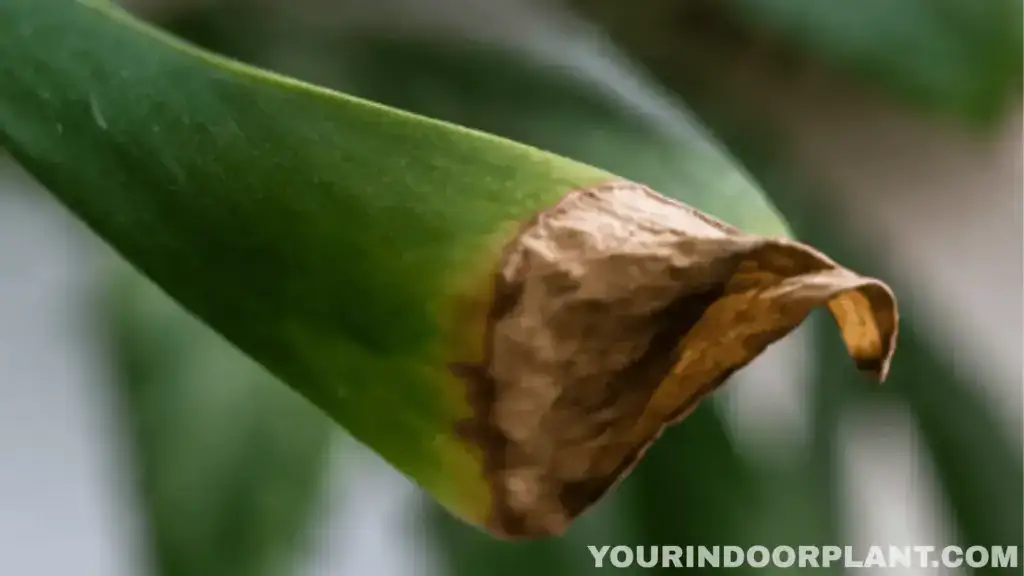
Signs to look for
- Brown tissue feels dry or crispy
- Browning begins at the leaf tip or outer edge
- Soil becomes very dry between waterings
- The pot feels unusually light
- Leaves may curl slightly or droop
- White mineral residue may appear on the soil or pot
Before increasing humidity, check whether the root zone is actually receiving enough water.
For more help judging when your plant needs water, see our guide on how to tell when a Monstera needs water.
What to do
When the soil has become very dry, water thoroughly until water drains from the bottom of the pot. Allow excess water to drain away rather than leaving the pot sitting in a full saucer.
Then adjust your watering routine based on the soil, pot size, light, and season rather than following a fixed calendar.
If the soil repeatedly becomes completely dry or difficult to re-wet, inspect the root ball and consider whether the potting mix has become compacted or hydrophobic.
2. Brown Tips Caused by Salt Buildup
If brown tips appear together with white crust on the soil or pot, salt buildup deserves consideration.
Mineral salts can accumulate when fertilizer is used frequently or when irrigation water contains a high concentration of dissolved minerals. The buildup can contribute to brown leaf tips and root stress.
Do not assume every brown tip means the plant needs fertilizer. Adding more fertilizer can make salt buildup worse.
The Missouri Botanical Garden recommends periodically flushing indoor plant soil to help remove accumulated salts and minerals from fertilizer or hard water.
What to check
Look for:
- White or chalky residue on the soil
- White buildup around the drainage holes
- Brown leaf tips appearing repeatedly
- A history of frequent fertilizing
- Little or no flushing of the potting mix
What to do
If salt buildup appears likely, flush the pot thoroughly with clean water and allow it to drain completely.
Reduce fertilizer frequency and avoid feeding a plant that is already showing signs of root stress.
If the plant has not been repotted for a long time and the soil has become compacted or heavily mineralized, replacing the mix may be more appropriate than repeatedly flushing it.
3. Brown, Papery Patches From Too Much Direct Sun
Brown, dry patches on the leaves that appear on the side facing a strong window can be a sign of sun damage.
Monsteras prefer bright light, but bright indirect light is different from several hours of harsh direct afternoon sun.
Sun-damaged tissue often looks different from moisture-related browning. Instead of starting neatly at the leaf tip, it may appear as irregular tan, brown, or papery patches where the light is strongest.
The Missouri Botanical Garden describes sunburn as browning or tan damage occurring on the portion of a leaf directly exposed to strong sunlight. Missouri Botanical Garden: Indoor Plant Environmental Problems
Signs of sun stress
- Browning is concentrated on the window-facing side
- Patches look dry or papery
- Damage follows areas exposed to strong sunlight
- The plant was recently moved closer to a bright window
- The rest of the leaf remains relatively healthy
What to do
Move the Monstera slightly farther from the window or use a sheer curtain to soften intense sunlight.
Do not move a plant from a dim location directly into several hours of strong sun. Increase light gradually when possible.
Your Monstera still needs plenty of light for healthy growth, so the goal is not to put it in a dark corner. If you are also seeing stretched growth and smaller new leaves, compare the situation with our Monstera Care Guide.
4. Soft Brown or Black Spots: Check the Soil and Roots
Soft, dark-brown or black areas are more concerning than a small crispy brown tip because they can occur alongside prolonged moisture and root problems.
The color alone does not prove that your Monstera has root rot. Instead, look at the texture, the soil, and the roots.
Wet soil that stays wet for an unusually long time can reduce oxygen around the roots. If root health declines, the plant may begin showing leaf symptoms.
Check for
- Soil that remains wet for many days
- Poor drainage
- A pot without drainage holes
- Soft or collapsing brown leaves
- Black or brown mushy roots
- A foul smell from the root zone
If you find actual root rot, remove the plant from the pot and inspect the roots. Healthy roots should not be mushy or collapse easily when touched.
Trim damaged roots with clean tools and repot into fresh, well-draining soil when necessary.
For a more detailed explanation of root problems, see our guide on how to treat root rot in houseplants.
You can also read our Monstera drainage hacks if the potting mix is staying wet for too long.
5. Why Are New Monstera Leaves Turning Brown Before Unfurling?
A new Monstera leaf turning brown before it fully unfurls deserves closer attention because the developing leaf depends heavily on consistent root and environmental conditions.
A mature leaf developing a small brown tip is not the same situation as a new leaf emerging already damaged.

Possible contributors include:
- Root stress
- Inconsistent moisture
- Severe drying followed by heavy watering
- Recent repotting
- Sudden temperature changes
- Very dry indoor conditions
- Physical damage while the leaf is unfurling
Start with the root zone rather than immediately increasing fertilizer or moving the plant.
If the soil has been staying wet for a long time, inspect the roots. If the soil repeatedly becomes bone dry, look at your watering method and make sure water is reaching the entire root ball.
Also consider recent changes. If the plant was moved, repotted, or exposed to a major change in temperature shortly before the new leaf became damaged, give it stable conditions while you investigate.
One damaged new leaf does not necessarily mean the entire plant is failing. What happens with the next leaf can tell you whether the underlying problem has actually been corrected.
6. Why Are the White Parts of My Variegated Monstera Turning Brown?
White and cream sections of a variegated Monstera can brown more readily because those areas contain little or no chlorophyll, but worsening browning still deserves a check of light and watering.
Variegated Monsteras such as Thai Constellation and Albo can have large areas of white tissue. Those sections contribute less to photosynthesis than green tissue and can be more vulnerable to stress.
Some browning of highly white tissue can occur naturally, but rapidly increasing browning is a reason to review the plant’s conditions.
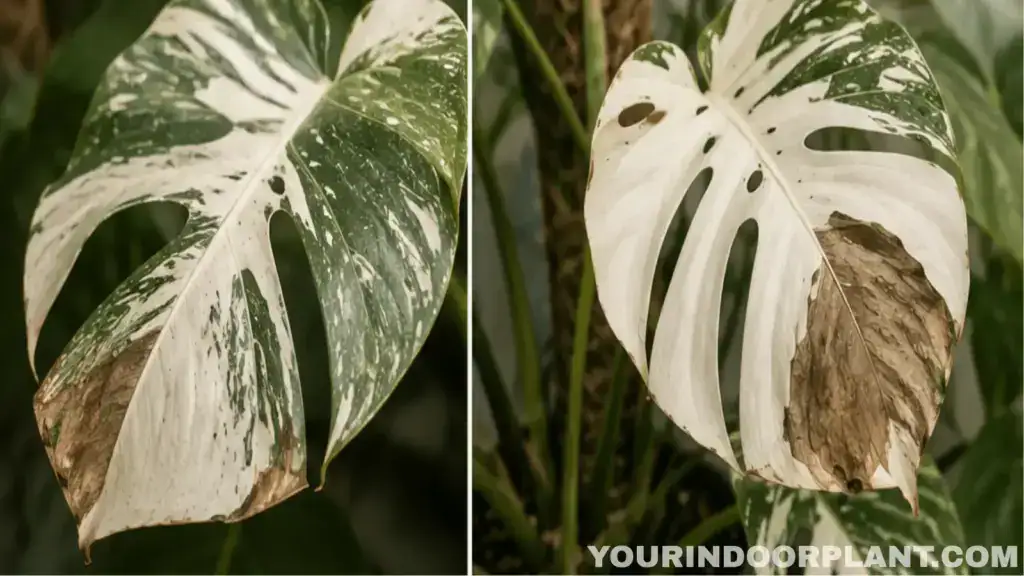
Check these factors
- Light: Strong direct sunlight can damage exposed pale tissue.
- Watering: Large swings between very dry and very wet conditions can stress the plant.
- Root health: A damaged root system can affect the plant’s ability to supply developing foliage.
- Overall growth: Healthy green growth elsewhere is a useful clue. Widespread decline is more concerning than one small brown patch on a white section.
Do not automatically cut every brown area from a variegated leaf. First determine whether the browning is stable or continuing to spread.
7. Low Humidity and Dry Indoor Air
Very dry indoor air can contribute to crispy brown edges, but humidity should not be your first diagnosis when the soil is also too dry or the roots are unhealthy.
Monsteras are tropical plants and generally perform better when indoor conditions are not extremely dry. However, brown edges are not a reliable humidity meter by themselves.
If the soil is consistently drying too far between waterings, fixing the root-zone moisture is more important than simply placing a humidifier next to the plant.
When dry air becomes more likely
Look for:
- Crispy rather than soft brown tissue
- Dry leaf edges and tips
- Several leaves showing similar edge damage
- Very dry indoor air
- Brown tips without persistently wet soil
- No obvious signs of pests or root problems
A humidifier can help maintain more consistent indoor humidity, particularly during dry heating seasons.
Avoid relying on occasional misting as the main solution. It provides only a temporary increase in surface moisture and does not correct a chronically dry root zone.
8. Brown Leaves After Repotting
A small amount of browning after repotting can occur when roots have been disturbed, but persistent or rapidly worsening damage should not automatically be blamed on transplant shock.
Repotting changes more than the container. You may also change the soil structure, moisture retention, root position, light exposure, and watering pattern at the same time.
That makes it easy to mistake a new care problem for ordinary adjustment.
After repotting, check
- Whether the new pot is much larger than the old one
- Whether the new soil stays wet longer
- Whether roots were heavily disturbed
- Whether the plant was moved to a different light level
- Whether watering frequency changed
- Whether the plant was exposed to cold or drafts
Keep conditions as stable as possible while the plant adjusts.
If you need to repot again because the soil is unsuitable or the roots are damaged, our guide on how to repot a Monstera plant walks through the process.
9. Natural Aging: When a Brown Leaf Is Not a Crisis
One older leaf gradually turning brown is usually less concerning than several leaves browning at the same time.
As a Monstera grows, an older lower leaf may eventually decline. The plant does not need to keep every leaf indefinitely.
Natural aging is more likely when:
- Only one old lower leaf is affected
- New growth looks healthy
- The rest of the foliage remains firm and green
- The browning progresses slowly
- There are no obvious soil, root, pest, or light problems
If several leaves begin browning simultaneously, especially younger leaves, look for an environmental or root-zone problem instead.
What If My Monstera Leaves Are Turning Brown and Yellow?
Brown and yellow leaves together usually deserve a closer look at watering and root conditions before you change fertilizer or humidity.
Yellowing often points toward a different part of the plant’s stress response than a dry brown tip.
If the soil is staying wet and several lower leaves are becoming yellow while brown areas develop, investigate drainage and roots.
If the soil is extremely dry and the leaves are both yellow and crispy, underwatering becomes more likely.
For a more detailed breakdown of yellowing patterns, see our guide to Monstera Leaves Turning Yellow.
The key is not to treat the colors separately without looking at the plant as a whole.
What If My Monstera Leaves Are Turning Black?
Blackening leaves are a reason to investigate quickly, especially when the tissue is soft and the soil stays wet.
Black tissue can occur with severe water or root problems, but not every dark spot has the same cause.
Check:
- Whether the tissue is soft or dry.
- Whether the soil is staying wet.
- Whether the problem is spreading.
- Whether the roots are healthy.
- Whether pests or physical damage are present.
Do not automatically apply fungicide simply because a leaf has a dark spot. Diagnose the conditions around the plant first.
Should I Cut Off Brown Monstera Leaves?
You can remove a fully brown or badly damaged leaf, but pruning will not fix the cause of the browning.
Brown tissue will not turn green again. If only a small tip is affected, you can leave it alone or trim the damaged section for appearance.
If most of the leaf has become brown, removing the entire leaf may make more sense.
Use clean, sharp scissors or pruners and avoid removing large amounts of healthy green tissue.
Most importantly, fix the underlying problem before removing healthy-looking leaves.
If you are pruning a larger Monstera and want to make cuttings, remember that a leaf alone cannot produce a new plant. A viable propagation cutting needs a node. See How to Propagate Monstera Cuttings for the details.
How to Diagnose Brown Monstera Leaves Step by Step
Start with the brown tissue itself, then work backward toward the soil, roots, light, and recent changes. Use this decision path:
- Is the brown area dry and crispy? → Check soil moisture, watering consistency, dry air, and salt buildup.
- Is it soft, dark, or black? → Check soil moisture, drainage, and roots.
- Is the damage concentrated on the window-facing side? → Check for strong direct sunlight.
- Is the browning mostly on white variegated tissue? → Check light, moisture consistency, and overall plant health.
- Is a new leaf turning brown before it unfurls? → Check roots, watering consistency, and recent environmental changes.
- Did the problem start after repotting? → Check root disturbance and whether the new soil is staying wet longer.
- Are brown leaves also turning yellow? → Compare the soil moisture and root conditions with our Monstera yellow leaves guide.
- Is there webbing, stippling, or sticky residue? → Inspect the undersides of the leaves and stems for pests.
Change one major factor at a time whenever possible. If you change watering, light, fertilizer, humidity, and soil simultaneously, you may improve the plant without knowing which change actually solved the problem.
How to Prevent Brown Monstera Leaves
Consistent care is the best way to prevent recurring browning.
- Water thoroughly rather than giving frequent small amounts.
- Check the soil before watering instead of following a fixed calendar.
- Use a pot with adequate drainage.
- Avoid keeping the Monstera in constantly wet soil.
- Provide bright, indirect light.
- Protect leaves from harsh direct afternoon sun.
- Avoid extreme swings between very dry and very wet soil.
- Fertilize moderately during active growth.
- Watch for mineral or fertilizer buildup.
- Keep the plant away from cold drafts and sudden temperature changes.
- Inspect new plants for pests before placing them near your collection.
- Check developing leaves as they unfurl so problems can be caught early.
Frequently Asked Questions
No. Once leaf tissue has turned brown, it will not regain its original green color. The important goal is to identify why the browning happened and prevent new leaves from developing the same damage.
You can remove fully brown leaves or trim small damaged areas for appearance. However, pruning does not correct the underlying problem, so check watering, roots, light, and other conditions first.
Brown crispy tips are commonly associated with dry soil, inconsistent watering, very dry indoor conditions, or salt buildup. Check soil moisture first rather than assuming low humidity is the only cause.
Brown new leaves can be associated with root stress, inconsistent moisture, recent repotting, environmental changes, or other stress during leaf development. Check the roots and recent changes before treating the plant.
Brown and yellow leaves can occur with watering problems, root stress, light problems, or other environmental factors. Check whether the soil is staying wet or becoming extremely dry and inspect the roots if conditions suggest a problem.
White variegated tissue contains little or no chlorophyll and can brown more easily than green tissue. Strong direct light, inconsistent watering, and general plant stress can make the problem worse.
Repotting can temporarily stress the plant because roots are disturbed and the new soil may hold moisture differently. Keep conditions stable, but investigate further if browning continues or becomes widespread.
There is no reliable fixed schedule. Check the soil and water thoroughly when the appropriate depth has dried, then adjust according to pot size, soil mix, light, temperature, and season.
Final Thoughts
Brown Monstera leaves are easier to diagnose when you look at the pattern instead of treating every brown spot the same way.
Crispy tips point you toward moisture and salt issues. Papery patches on exposed leaves suggest looking at light. Soft dark spots make soil and roots more important to investigate. New leaves that brown before unfurling deserve closer attention to root health and recent environmental changes.
Start with the simplest checks: where is the browning, what does the tissue feel like, and what is happening below the soil?
Once you identify the underlying stress, the goal is not to make the damaged leaf green again. It is to create conditions that allow the next leaf to emerge healthy.